
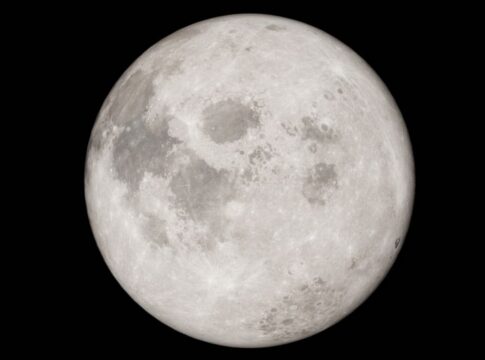
9 Fascinating Facts About the Moon Drifting From Earth
By TrivBits, Staff Writer — Published August 18, 2026
Table of Contents
- Key Takeaways
- Understanding the Moon Drifting From Earth Phenomenon
- How Ancient Evidence Reveals the Moon’s Past Position
- The Nine Key Facts
- Frequently Asked Questions
Every year, the Moon slips a little farther from our planet—about 1.5 inches, to be precise. This slow-motion escape has been underway for billions of years, and it’s reshaping everything from the length of our days to the intensity of ocean tides. The moon drifting from Earth isn’t science fiction; it’s a measurable phenomenon that reveals surprising truths about our cosmic relationship with our only natural satellite. What causes this gradual separation, and what does it mean for the future of life on our planet?
The mechanics behind this drift involve gravitational forces, tidal friction, and angular momentum transfer—a celestial dance that has profound implications. From ancient eclipses that helped scientists discover this drift to the eventual fate of our 24-hour day, these facts explore one of astronomy’s most intriguing ongoing processes.
Key Takeaways
- The Moon recedes from Earth approximately 1.5 inches (3.8 centimeters) annually due to tidal forces.
- This drift is gradually slowing Earth’s rotation, making our days longer by about 1.7 milliseconds per century.
- Ancient coral fossils reveal that days were only 22 hours long roughly 400 million years ago.
- Laser reflectors placed on the Moon by Apollo astronauts allow scientists to measure this drift with millimeter precision.
- The Moon-Earth distance varies throughout its elliptical orbit, ranging from about 225,623 to 252,088 miles.
- In about 50 billion years, the Moon would theoretically stabilize at a fixed distance, though the Sun will likely engulf both long before then.
Understanding the Moon Drifting From Earth Phenomenon
The mechanism driving the Moon’s recession involves a complex energy transfer between Earth’s rotation and the Moon’s orbit. As Earth spins, its gravitational pull creates tidal bulges in the oceans—two on opposite sides of the planet. Because Earth rotates faster than the Moon orbits, these bulges actually move ahead of the point directly beneath the Moon. The gravitational pull of these offset bulges tugs the Moon forward in its orbit, gradually accelerating it. When an orbiting object speeds up, it paradoxically moves to a higher, slower orbit—and that’s exactly what the Moon does, spiraling slowly outward.
This process simultaneously steals rotational energy from Earth, causing our planet to spin more slowly. It’s a beautiful example of conservation of angular momentum in action. The energy doesn’t disappear; it simply transfers from Earth’s rotation to the Moon’s orbital motion. NASA and other space agencies have confirmed these measurements using laser ranging experiments that bounce light off reflectors left on the lunar surface during the Apollo missions. The precision is remarkable—scientists can measure the Moon’s position to within a few millimeters.
How Ancient Evidence Reveals the Moon’s Past Position
Geologists and paleontologists have found ingenious ways to peer into Earth’s rotational past. Ancient coral fossils, for instance, preserve growth rings similar to tree rings—but with daily and yearly patterns. By counting these microscopic bands, researchers determined that days were significantly shorter hundreds of millions of years ago. Roughly 400 million years ago, during the Devonian period, a year contained about 400 days, each lasting approximately 22 hours. This means the Moon was considerably closer then, exerting stronger gravitational forces and creating more dramatic tides.
Tidal rhythmites—layered sedimentary rocks formed by ancient tidal cycles—provide additional evidence. These geological records capture the ebb and flow of prehistoric tides, allowing scientists to calculate the Moon’s distance at various points in Earth’s history. The data consistently shows the same pattern: the Moon has been steadily retreating since its formation.
The Nine Key Facts
1. The Moon Recedes at About the Speed Your Fingernails Grow
The 1.5-inch annual drift might sound insignificant, but it accumulates over geological timescales. This rate is roughly equivalent to the speed at which human fingernails grow. Over the past billion years, this has added up to tens of thousands of miles of separation. The measurement itself is a triumph of modern technology—laser ranging experiments can detect changes of just a few millimeters by timing how long it takes light to travel to the Moon and back.
2. Earth’s Days Are Getting Longer Because of This Drift
As the Moon pulls away, Earth’s rotation slows by approximately 1.7 milliseconds per century. This might seem trivial, but it adds up. In about 140 million years, assuming the current rate continues, a day will be 25 hours long. This gradual deceleration has profound implications for timekeeping—atomic clocks occasionally require “leap seconds” to keep our official time synchronized with Earth’s actual rotation, which doesn’t follow a perfectly regular schedule.
3. The Moon Was Once Close Enough to Create Massive Tides
When the Moon first formed—likely from debris created when a Mars-sized object collided with early Earth—it orbited much closer, perhaps 15,000 to 20,000 miles away rather than today’s average of 238,855 miles. At that distance, the tidal forces would have been extraordinary, creating ocean tides hundreds of feet high. These massive tides would have generated significant internal heating in both bodies through tidal friction, potentially influencing early volcanic activity and the evolution of Earth’s crust.
4. Ancient Eclipses Help Scientists Calculate Historical Drift Rates
Historical records of solar eclipses provide a clever way to verify the Moon’s recession. Chinese, Babylonian, and Greek astronomers meticulously recorded eclipses thousands of years ago. By comparing where those eclipses were visible then versus where they should have been visible if the Moon’s orbit had remained constant, scientists can calculate how much the Moon has drifted. These ancient observations align beautifully with modern laser ranging data, confirming the Moon has been receding at a relatively steady rate.
5. Tidal Forces Work Both Ways
While Earth’s tides affect the Moon’s orbit, the Moon also raises tides in Earth’s crust and oceans. The solid Earth actually bulges by several inches in response to the Moon’s gravitational pull, though we don’t notice because everything moves together. These Earth tides dissipate energy as heat through friction in rocks and ocean water, which is the mechanism that slows our planet’s rotation. The energy lost to this friction amounts to about 3.75 terawatts—roughly equivalent to the power consumption of a medium-sized country.
6. The Moon’s Orbit Isn’t Perfectly Circular
The Moon follows an elliptical path, meaning its distance from Earth varies throughout each month. At perigee (closest approach), the Moon sits about 225,623 miles away; at apogee (farthest point), it reaches about 252,088 miles. This 26,000-mile difference affects how large the Moon appears in our sky and determines whether a solar eclipse will be total or annular. When the Moon is closer during its drift cycle, it appears larger—a phenomenon popularly called a “supermoon” when the full Moon coincides with perigee.
7. The Drift Rate Hasn’t Been Constant Throughout History
The 1.5-inch annual rate represents the current average, but the drift rate has varied over Earth’s history. Factors like the configuration of continents, ocean basin shapes, and sea levels all influence how efficiently tidal energy dissipates. During periods when continents were arranged differently, the tidal resonance patterns changed, speeding up or slowing down the energy transfer. Some geological evidence suggests periods when the recession rate may have been slower or faster than today’s measurement.
8. Eventually the Moon’s Drift Will Stop
In theory, the Moon will continue receding until Earth and the Moon become tidally locked with each other—meaning both would always show the same face to each other, and a day on Earth would equal a lunar month. At that point, estimated to occur in about 50 billion years, the Moon would orbit at approximately 340,000 miles from Earth, and an Earth day would last about 47 current days. However, this will never actually happen because the Sun will expand into a red giant in about 5 billion years, likely engulfing or destroying both bodies long before tidal locking completes.
9. This Phenomenon Affects Earth’s Climate and Stability
The Moon’s gravitational influence stabilizes Earth’s axial tilt, which currently varies only between about 22.1 and 24.5 degrees over a 41,000-year cycle. This relatively stable tilt is crucial for climate predictability and the development of complex life. As the Moon drifts away and its stabilizing influence gradually weakens, Earth’s axial tilt could eventually vary more dramatically over long timescales, potentially causing extreme climate swings. Mars, which lacks a large stabilizing moon, has experienced chaotic tilt variations that likely contributed to its loss of atmosphere and surface water.
Frequently Asked Questions
Will the Moon eventually drift away completely and leave Earth’s orbit?
No. The Moon will never escape Earth’s gravity entirely. It will continue drifting outward until both bodies become tidally locked with each other, at which point the drift will cease. This equilibrium point would be reached in roughly 50 billion years, though the Sun’s expansion will make this theoretical endpoint irrelevant.
How do scientists measure something as small as 1.5 inches over 238,000 miles?
Researchers use laser ranging technology, bouncing laser beams off reflectors placed on the Moon by Apollo astronauts and Soviet robotic missions. By precisely timing how long light takes to make the round trip—about 2.5 seconds—scientists can calculate the distance to millimeter-level accuracy and detect changes over time.
Did the Moon’s closer position affect the evolution of life on Earth?
Quite possibly. The stronger tides created by a closer Moon would have mixed ocean waters more vigorously, distributing nutrients and affecting coastal environments where some scientists believe life may have originated. The faster Earth rotation also meant shorter day-night cycles, which could have influenced the evolution of circadian rhythms in early organisms.
Are other moons in our solar system drifting away from their planets?
It depends on the moon’s orbit and rotation. Moons orbiting faster than their planet rotates (like our Moon) drift outward. Moons orbiting slower than their planet spins, such as Mars’s moon Phobos, actually spiral inward and will eventually crash into their planet or break apart. Phobos is predicted to meet this fate in about 50 million years.
The Moon’s slow retreat from Earth reminds us that even the most permanent-seeming features of our cosmos are constantly changing. This celestial separation, measured in the growth rate of fingernails, connects ancient coral reefs to future timekeeping challenges—a testament to how the grandest cosmic processes reveal themselves in the smallest measurements.