
By TrivBits, History Desk — Published August 30, 2026
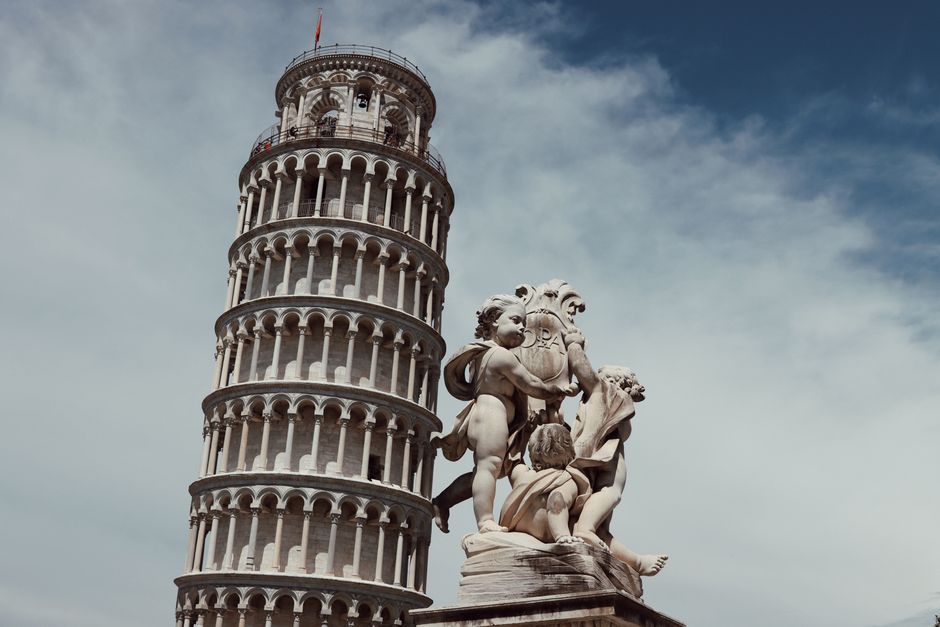
Table of Contents
- Key Takeaways
- The Medieval Mistake That Created an Icon
- Why Physics Allows the Impossible
- The Race to Save a Landmark
- Comparing Famous Tilting Towers
- Lessons From an Ancient Engineering Failure
- Frequently Asked Questions
- Sources
For more than eight centuries, the Leaning Tower of Pisa has defied gravity in ways that seem almost impossible. While most buildings topple when they tilt just a few degrees, this medieval bell tower has leaned at angles that would doom any modern structure. The truth about the leaning tower reveals a fascinating story of engineering mistakes, stubborn persistence, and the surprising physics that keep it standing against all odds.
Built during an era when Italian city-states competed to construct the most impressive monuments, the tower became famous not for its architectural perfection but for its spectacular flaw. What began as a construction disaster in the 12th century transformed into one of history’s most recognizable landmarks, drawing millions who marvel at a building that shouldn’t exist.
Key Takeaways
- The tower started leaning during construction in 1173 due to soft ground consisting of clay, fine sand, and shells beneath the foundation
- Construction halted twice over nearly 200 years, and these pauses paradoxically helped save the tower by allowing the soil to settle
- The tower’s lean increased to a dangerous 5.5 degrees by 1990, placing it close to its tipping point
- Modern engineering interventions between 1990 and 2001 reduced the tilt by about half a degree, buying centuries of stability
- The tower remains standing partly because its center of gravity stays within its base, despite the dramatic angle
- The same soft soil that caused the problem also absorbs energy from earthquakes, protecting the structure from seismic damage
The Medieval Mistake That Created an Icon
Construction began in August 1173 during a period of prosperity for the maritime republic of Pisa. The city wanted a bell tower—called a campanile—to complement its cathedral, part of an ambitious complex designed to showcase Pisa’s wealth and power. The foundation was laid just three meters deep in unstable subsoil, a critical error that engineers wouldn’t understand for centuries.
By the time workers completed the third floor in 1178, the tower had already begun tilting to the north. Construction stopped. Not because anyone recognized the danger, but because Pisa went to war with neighboring Genoa, Florence, and Lucca. This century-long pause proved fortunate. The soil beneath the foundation compressed and settled, gaining just enough stability to support additional weight when work resumed in 1272.
Medieval builders attempted to correct the lean by making the columns and arches on the high side slightly taller than those on the low side. This created a subtle banana-like curve. But the tower kept leaning, now tilting southward. Construction stopped again in 1284 after Pisa’s naval defeat at the Battle of Meloria crushed the city’s political power. The tower stood incomplete for another 90 years.
The bell chamber was finally added in 1372, nearly two centuries after the foundation was laid. By then, the lean had become part of the tower’s identity.
Why Physics Allows the Impossible
The tower survives because of a delicate balance between gravity, ground conditions, and structural geometry. At 56 meters tall and weighing approximately 14,500 metric tons, the tower exerts enormous pressure on its foundation. The lean means this weight distributes unevenly, creating intense compression on the south side.
The key to stability lies in the center of gravity. As long as an imaginary vertical line drawn from the tower’s center of mass falls within the base, the structure won’t topple. For decades, that line crept closer to the edge. By 1990, the tower leaned 5.5 degrees from vertical—engineers calculated it was within a hair’s breadth of collapse.
Paradoxically, the soft soil that caused the tilt also helps the tower survive. The ground consists of three distinct layers: upper clay, marine clay, and dense sand. This composition allows the foundation to sink and compress gradually rather than failing catastrophically. The same soft ground dampens seismic waves during earthquakes, which explains how the tower survived multiple significant tremors over the centuries when more stable buildings fell.
The Race to Save a Landmark
By the late 20th century, the tower had become too dangerous to ignore. The lean was increasing by about one millimeter per year. In 1990, the Italian government closed the tower to tourists and assembled an international committee of engineers, historians, and restoration experts.
The challenge was unprecedented: reduce the tilt without damaging the ancient stonework or destroying the tower’s character. Early proposals ranged from subtle to radical. Some suggested freezing the ground with liquid nitrogen. Others proposed injecting concrete or installing visible supports. Each idea carried risks.
The breakthrough came from a technique called soil extraction. Engineers drilled carefully angled holes beneath the north side of the foundation and removed small amounts of soil. Gravity did the rest—the tower gradually settled into the space, reducing the lean. Between 1999 and 2001, workers extracted about 70 cubic meters of earth in tiny increments, monitoring the tower’s movement with laser precision.
The intervention worked. The tower straightened by approximately 45 centimeters, reducing the angle from 5.5 degrees to about 4 degrees. Engineers estimate this bought another 200 years of stability, possibly more.
Comparing Famous Tilting Towers
| Tower | Location | Angle of Lean | Century Built |
|---|---|---|---|
| Tower of Pisa | Italy | 3.97 degrees (after correction) | 12th-14th |
| Two Towers of Bologna | Italy | 4 degrees (Garisenda) | 12th |
| Oude Kerk Tower | Netherlands | 2 degrees | 14th |
| Tiger Hill Pagoda | China | 2.32 degrees | 10th |
Lessons From an Ancient Engineering Failure
Modern engineers study the Tower of Pisa not despite its flaw but because of it. The structure demonstrates how buildings interact with soil over centuries, offering insights applicable to construction in earthquake zones and areas with unstable ground. The tower became an accidental laboratory for understanding long-term soil mechanics and structural adaptation.
The medieval builders’ attempts to compensate for the lean—making one side taller, adjusting column heights—show that past civilizations understood practical problem-solving even without modern physics. They couldn’t calculate stress distributions or model soil compression, but they observed, adapted, and built something that endured.
The tower also illustrates how construction pauses can benefit unstable structures. Those century-long breaks allowed soil consolidation that might not have occurred under continuous building pressure. Patience, whether intentional or forced by war and economics, became part of the solution.
Frequently Asked Questions
Will the Leaning Tower of Pisa ever fall down?
Not in the foreseeable future. The engineering work completed in 2001 reduced the lean enough to ensure stability for at least another 200 years, possibly longer. Ongoing monitoring allows engineers to detect any dangerous changes early. Barring an extraordinary event like a massive earthquake or deliberate destruction, the tower should stand for many more centuries.
Why don’t they just straighten the tower completely?
The lean is now the tower’s defining characteristic and the reason millions visit Pisa each year. Straightening it completely would eliminate its historical and cultural significance. Additionally, attempting to fully correct centuries of tilt could damage the ancient stonework. The goal was never perfection but rather ensuring the tower remains safe while preserving its iconic appearance.
How many other towers in Italy lean like Pisa’s?
Italy has numerous leaning towers, particularly in regions with soft or marshy soil. The Garisenda Tower in Bologna actually leans at a steeper angle than Pisa’s tower. The campanile of the Church of San Giorgio dei Greci in Venice and the bell tower of the Church of San Martino in Burano also tilt noticeably. Soft ground combined with medieval construction techniques created many such structures across the Italian peninsula.
Can you still climb to the top of the tower?
Yes, the tower reopened to visitors in 2001 after the stabilization work concluded. Tourists can climb the 294 steps to the bell chamber, though access is limited to small groups to prevent too much weight on the structure at once. Walking up the tilted spiral staircase creates a disorienting experience as your sense of vertical constantly shifts.
The Leaning Tower of Pisa stands as proof that even spectacular mistakes can become treasured legacies. What medieval builders saw as a shameful flaw became a monument to human persistence and ingenuity. Every year, millions photograph themselves pretending to push or hold up the tower, participating in a tradition as tilted as the structure itself. The real marvel isn’t that it leans—it’s that we learned how to keep it leaning without letting it fall.