
By TrivBits, Staff Writer — Published October 14, 2026
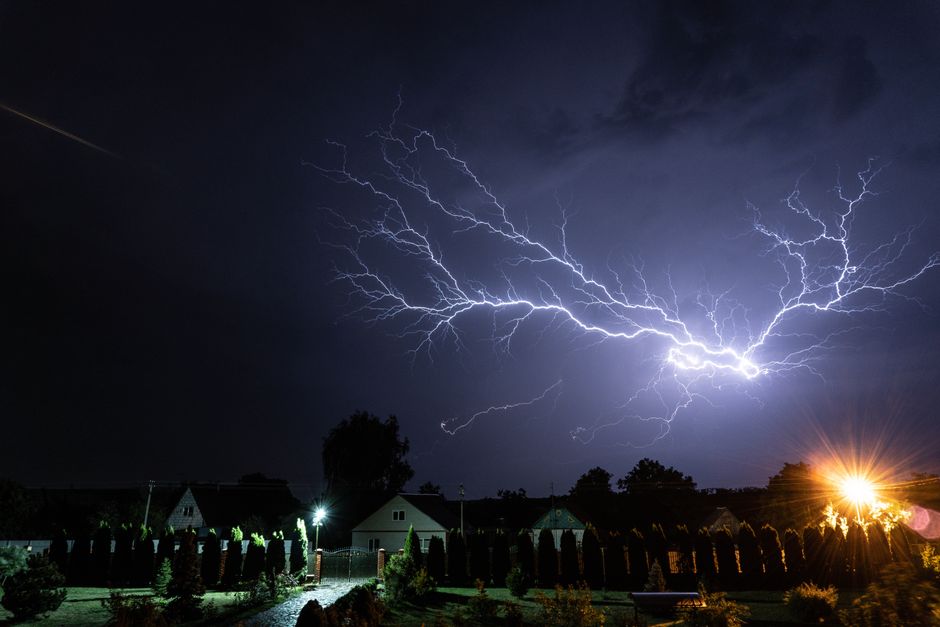
Table of Contents
- Key Takeaways
- How Causes Lightning Strike Patterns Really Work
- Why Tall Structures Become Lightning Magnets
- The Geographic and Seasonal Patterns Nobody Talks About
- How Lightning Protection Systems Exploit the Physics
- Debunking Related Lightning Myths
- Frequently Asked Questions
- Sources
You’ve heard the old saying: “Lightning never strikes the same place twice.” It’s one of those phrases people repeat with absolute confidence, as if nature follows a strict no-repeats policy. Here’s the surprising truth: lightning absolutely does strike the same place twice—and sometimes dozens of times. Understanding what causes lightning to strike, and why it favors certain locations, reveals fascinating facts about electrical physics and atmospheric behavior that contradict this persistent myth.
The reality is far more interesting than the folklore. Tall structures, specific geographical features, and the physics of electrical discharge all conspire to make some spots lightning magnets. Did you know the Empire State Building gets hit roughly 20 to 25 times per year? Some lightning rods and towers experience multiple strikes during a single storm. The truth behind this myth opens a window into one of nature’s most powerful and misunderstood phenomena.
Key Takeaways
- Lightning frequently strikes the same location multiple times, especially tall structures and elevated terrain
- Electrical resistance and height are the primary factors determining where lightning strikes, not random chance
- The myth likely originated from observing rare strikes in flat, open areas rather than understanding the underlying physics
- Lightning can strike the same spot several times within a single storm due to consistent atmospheric conditions
- Understanding strike patterns has led to effective lightning protection systems that intentionally attract strikes
- Some natural features like mountain peaks and lone trees become repeat strike zones year after year
How Causes Lightning Strike Patterns Really Work
Lightning is essentially nature’s way of balancing electrical charges between clouds and the ground. Storm clouds develop enormous electrical imbalances—negative charges accumulate at the bottom while positive charges gather at the top. The ground below becomes positively charged in response. When the electrical potential difference becomes too great, the air itself breaks down and becomes conductive.
Here’s where it gets interesting. Lightning doesn’t just strike randomly. It follows the path of least resistance, seeking out the easiest route to complete the electrical circuit. Tall objects provide a shorter path through the insulating air. Metal conducts electricity better than wood or earth. Moisture enhances conductivity. These factors remain constant, which is precisely why lightning shows a preference for specific locations.
The initial strike creates what scientists call a “stepped leader”—an invisible channel of ionized air that branches downward in roughly 50-meter segments. As this descends, positive streamers reach upward from the ground, especially from tall or pointed objects. When they connect, the main discharge follows—the brilliant flash we see. That ionized channel can remain partially conductive for a short time, making follow-up strikes along the same path more likely within seconds or minutes.
Why Tall Structures Become Lightning Magnets
The Empire State Building isn’t just occasionally struck by lightning—it’s a reliable target. The same physics applies to radio towers, skyscrapers, church steeples, and mountain peaks. Height matters tremendously because it reduces the distance electricity must travel through resistive air.
Consider a 100-meter tower on flat ground. Lightning forming at cloud base (typically 600 to 2,000 meters high) has about 500 to 1,900 meters less air to ionize if it hits the tower versus the surrounding ground. That’s an enormous advantage in electrical terms. The tower essentially reaches up into the storm, volunteering itself as the discharge point.
Park rangers know certain trees get hit repeatedly—sometimes you can see the scarring from multiple strikes over the years. A lone oak on a hilltop becomes a natural lightning rod, struck season after season. The tree’s height advantage doesn’t change, so neither does its appeal to passing thunderstorms. Some ancient trees bear dozens of lightning scars, testament to centuries of being in exactly the wrong (or right) place.
The Geographic and Seasonal Patterns Nobody Talks About
Certain regions experience far more lightning than others, creating predictable hotspots. Central Africa, particularly the Democratic Republic of Congo, holds the global record for lightning frequency. In the United States, Florida’s Gulf Coast sees more lightning than almost anywhere else in the country, with some areas experiencing over 100 thunderstorm days annually.
These patterns exist because lightning requires specific atmospheric conditions: strong updrafts, moisture, and instability. Geography shapes these conditions. Mountain ranges force air upward, creating turbulence and charge separation. Bodies of water provide moisture and temperature contrasts. Flat plains under summer sun generate powerful convective storms.
| Location Type | Strike Frequency | Primary Factor |
|---|---|---|
| Tall isolated structures | Multiple strikes per storm season | Height advantage, reduced air gap |
| Mountain peaks | Frequent during storm passage | Elevation, moisture convergence |
| Flat open fields | Rare, seemingly random | No preferred path, appears random |
| Water surfaces | Moderate, targets boats/objects | Conductivity, isolated tall objects |
How Lightning Protection Systems Exploit the Physics
Benjamin Franklin figured out the essential principle in the 1750s: you can’t prevent lightning, but you can control where it goes. His lightning rod invention deliberately creates an attractive strike point, then safely channels the enormous current into the ground. Modern systems follow the same basic concept, though with refined engineering.
The unknown fact here is that protection systems actually increase the likelihood of strikes to a structure—that’s the entire point. A properly installed lightning rod makes a building more attractive to lightning, not less. The rod extends above the roofline, has a pointed tip to enhance the electric field concentration, and connects via thick conductors to grounding rods buried deep in the earth.
When lightning does strike (and it will, repeatedly), the system provides a low-resistance path that bypasses the building’s structure, wiring, and occupants. The electrical energy dissipates harmlessly into the ground. Buildings with these systems can be struck hundreds of times over their lifespan without damage—proof that lightning not only strikes twice but often.
Debunking Related Lightning Myths
The “never strikes twice” myth has company. Many people believe lightning only occurs during rain, but dry lightning starts countless wildfires. Others think rubber tires protect you in a car—actually, it’s the metal shell that acts as a Faraday cage, conducting electricity around you. The rubber provides no meaningful insulation against millions of volts.
Another persistent myth: lightning always takes the shortest path. Not quite. It takes the path of least resistance, which considers both distance and conductivity. A lightning bolt might bypass a shorter path through dry air to hit a taller but more conductive target slightly farther away. The physics is more nuanced than simple geometry.
Perhaps the most dangerous myth is that being struck is always fatal. Roughly 90 percent of lightning strike victims survive, though many suffer serious injuries. The current typically flashes over the skin’s surface rather than through vital organs, especially if the person is wet (which, counterintuitively, increases surface conductivity and reduces internal current).
Frequently Asked Questions
Can lightning strike the exact same spot twice in one storm?
Absolutely. The ionized channel created by the first strike can remain partially conductive for several minutes, making subsequent strikes along the same path more likely. Multiple strikes separated by seconds or minutes often follow nearly identical paths, which is why high-speed cameras sometimes capture several flashes hitting the same point during a single storm cell.
Why does the myth persist if it’s so obviously false?
The saying likely originated as a figure of speech about improbable events, not as a literal statement about lightning physics. In flat, open areas where strikes are relatively rare and distributed, people rarely witnessed the same location struck repeatedly. The phrase became popular before scientific understanding of electricity was widespread, and catchy sayings tend to outlive their accuracy.
What makes certain buildings get struck more than others?
Height is the dominant factor, but building materials, location, and surrounding terrain also matter. A tall metal structure on a hilltop in a lightning-prone region will be struck far more frequently than a short wooden building in a valley. The Empire State Building, Willis Tower, and similar skyscrapers serve as preferential discharge points for storms passing over cities.
Is it safe to be near a place that was just struck?
The immediate area can actually be more dangerous for several minutes after a strike. The ground can remain energized, creating dangerous step potentials. The ionized air channel may attract additional strikes. If you’re caught outside during a thunderstorm, don’t shelter under a tree that shows signs of previous strikes—those scars indicate it’s a repeat target.