
By TrivBits, Staff Writer — Published October 9, 2026
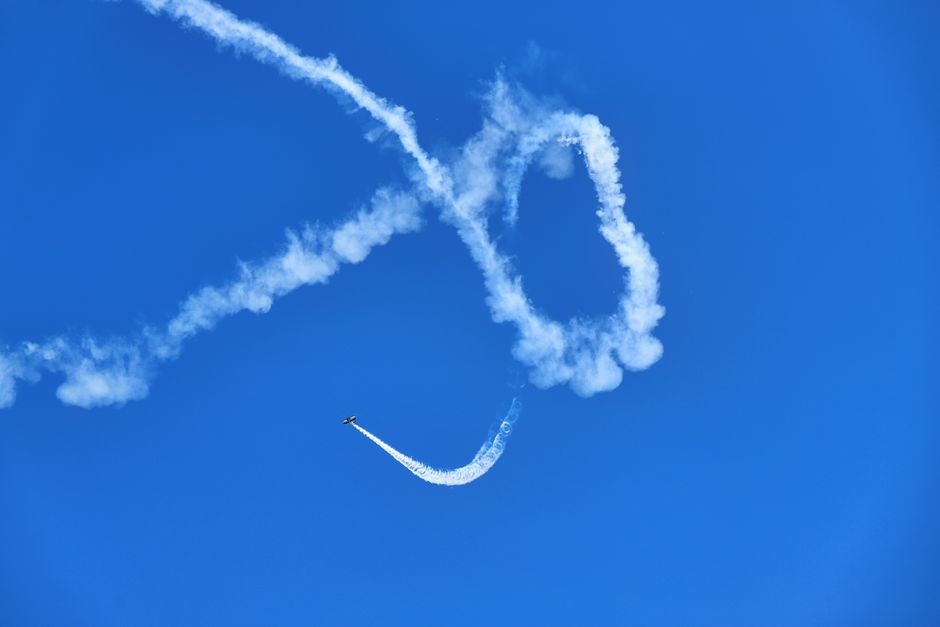
Table of Contents
- Key Takeaways
- The Science Behind What Causes Airplane Contrails
- Why Some Contrails Vanish While Others Linger
- Contrails vs. Chemtrails: Busting the Myths
- The Climate Connection
- Fascinating Contrail Facts and Observations
- Frequently Asked Questions
- Sources
Look up on a clear day and you’ll likely spot white streaks slicing across the blue sky. These airplane contrails—short for “condensation trails”—are one of aviation’s most visible signatures, yet surprisingly few people understand what causes airplane contrails to form. Did you know these cloudy ribbons aren’t simply exhaust smoke? The truth behind contrails involves fascinating atmospheric physics, temperature extremes, and the surprising role of water vapor at cruising altitude.
Despite their everyday presence, contrails remain shrouded in myths and misconceptions. Some believe they’re purely pollution, while conspiracy theories have spawned entire movements around “chemtrails.” The real science is far more interesting than fiction, revealing how jet engines inadvertently create clouds in the coldest reaches of our atmosphere.
Key Takeaways
- Contrails form when hot, humid jet exhaust meets extremely cold air at high altitudes, causing water vapor to instantly condense and freeze into ice crystals.
- Temperature at cruising altitude must be below approximately -40°F (-40°C) for persistent contrails to develop and remain visible.
- Contrails are essentially human-made cirrus clouds composed primarily of ice, not chemical pollutants as some myths suggest.
- Atmospheric humidity determines whether contrails disappear within seconds or persist for hours, sometimes spreading across the sky.
- Contrails can impact climate by trapping heat in the atmosphere, making them an active area of climate research.
- The number of visible contrails varies dramatically based on flight paths, weather conditions, and the specific atmospheric layers planes traverse.
The Science Behind What Causes Airplane Contrails
Jet engines burn fuel at scorching temperatures, producing exhaust loaded with water vapor as a combustion byproduct. When this hot, moist exhaust blasts into the frigid air at typical cruising altitudes—usually between 30,000 and 40,000 feet—something remarkable happens almost instantaneously.
The temperature shock causes the water vapor to condense into tiny droplets. But here’s the critical part: at these extreme altitudes, temperatures hover around -40°F to -70°F (-40°C to -56°C). The water droplets don’t stay liquid for long. They freeze into minuscule ice crystals within a fraction of a second, creating the white trail we observe from the ground.
Think of it like your breath on a winter morning, magnified a million times. You’re exhaling warm, humid air that instantly condenses when it hits cold air. Contrails work on the same principle, just with much more dramatic temperature differences and at altitudes where the air is incredibly thin and cold.
The ice crystals forming contrails are remarkably small—typically just a few micrometers across. Yet billions of these tiny crystals clustered together become visible as brilliant white streaks stretching for miles behind aircraft.
Why Some Contrails Vanish While Others Linger
Here’s where atmospheric conditions become crucial. Not all contrails behave the same way, and the difference comes down to humidity levels in the upper atmosphere.
Short-lived contrails appear in relatively dry air. The ice crystals form but quickly sublimate—transitioning directly from solid ice back to invisible water vapor—within seconds or minutes. These brief trails disappear almost as fast as they form, leaving little trace of the aircraft’s passage.
Persistent contrails tell a different story. When the upper atmosphere contains high humidity levels (specifically, when it’s supersaturated with respect to ice), those ice crystals don’t sublimate. Instead, they remain frozen and may even grow as additional atmospheric moisture freezes onto them. These contrails can last for hours, gradually spreading and diffusing until they resemble natural cirrus clouds.
Sometimes you’ll see multiple planes at similar altitudes, with one producing a thick, lasting contrail while another leaves barely a trace. They’re flying through different atmospheric layers with varying temperature and humidity profiles—invisible boundaries that dramatically affect contrail formation.
Contrails vs. Chemtrails: Busting the Myths
Let’s address the elephant in the room: chemtrail conspiracy theories. These unfounded claims suggest governments or organizations deliberately spray chemicals from aircraft for nefarious purposes. The scientific community has thoroughly debunked these theories, but they persist online.
Real atmospheric scientists, meteorologists, and aviation experts unanimously confirm that contrails are simply ice crystals formed through well-understood physical processes. The composition is primarily water ice, with trace amounts of carbon dioxide, nitrogen oxides, sulfates, and soot particles from combustion—the normal byproducts of burning jet fuel.
The variation in contrail appearance—thickness, length, persistence—results entirely from atmospheric conditions, aircraft type, engine efficiency, and altitude. There’s no mystery chemical payload. The trivia here is that the truth is actually more interesting than the fiction: we’re watching real-time cloud formation triggered by human technology interacting with natural atmospheric physics.
The Climate Connection
While contrails aren’t sinister chemical releases, they do have measurable environmental effects that researchers take seriously. Persistent contrails and the cirrus clouds they spawn can influence Earth’s radiation balance—the interplay between incoming solar energy and outgoing heat.
Contrail cirrus clouds act somewhat like a blanket, trapping infrared radiation that would otherwise escape to space. This creates a warming effect. On the other hand, they also reflect some incoming sunlight back to space, creating a cooling effect. Current research suggests the warming effect slightly outweighs the cooling, meaning contrails contribute to climate warming, though to a much smaller degree than carbon dioxide emissions from the fuel itself.
Scientists estimate that aviation’s climate impact from contrails might be comparable to or even exceed the impact from the CO2 emissions of aviation alone, though uncertainties remain. This has sparked research into contrail avoidance strategies—routing flights to avoid humidity-rich atmospheric layers where persistent contrails form.
Fascinating Contrail Facts and Observations
Contrails reveal invisible atmospheric rivers and currents. When you see a contrail bending, twisting, or breaking into segments, you’re witnessing wind shear—different layers of air moving at different speeds or directions. It’s a visible map of otherwise invisible turbulence.
Military aircraft sometimes produce colorful contrails during airshows, but these are aerobatic smoke systems, not contrails. They use special smoke oil injected into the exhaust or released from dedicated smoke generators. Real contrails are always white or light gray because they’re made of ice crystals.
The first contrails were observed during high-altitude flights in the 1920s, but they became common only when commercial aviation reached higher cruising altitudes in the jet age. Propeller aircraft flying at lower altitudes rarely produced them because the air wasn’t cold enough.
Contrail shadows can sometimes be spotted on lower cloud layers, creating dramatic visual effects. Under the right lighting conditions, you might even see a contrail casting its shadow on the ground, though this requires specific sun angles and atmospheric clarity.
Frequently Asked Questions
Do all airplanes produce contrails?
No, contrails only form under specific atmospheric conditions. The air must be cold enough (below approximately -40°F) and sufficiently humid. Aircraft flying at lower altitudes or through warmer, drier air layers won’t produce visible contrails, even though their engines still emit water vapor. The same plane might leave a contrail one day and none the next, depending entirely on the atmospheric conditions it encounters.
Are contrails harmful to breathe?
Contrails form at extremely high altitudes—typically 30,000 to 40,000 feet—far above the air we breathe at ground level. By the time any particles from that altitude reach the surface, they’re dispersed across enormous areas and diluted to negligible concentrations. The ice crystals themselves sublimate back into water vapor. Ground-level air quality is far more affected by surface pollution sources than by contrails miles overhead.
Why do some contrails have gaps in them?
Gaps in contrails indicate that the aircraft flew through atmospheric layers with different temperature or humidity levels. A plane might pass through a pocket of drier air or slightly warmer air where conditions don’t support contrail formation, creating a visible break in the trail. These gaps essentially map the invisible three-dimensional structure of the atmosphere.
Can contrails affect weather?
Individual contrails have minimal direct impact on weather, but extensive contrail coverage can slightly influence local temperature. Studies of the three-day period after September 11, 2001, when U.S. flights were grounded and skies were contrail-free, showed measurable differences in daily temperature ranges. Persistent contrails that evolve into cirrus clouds can reduce nighttime cooling and daytime heating, though the effects are subtle compared to natural weather systems.