
By TrivBits, Staff Writer — Published August 21, 2026
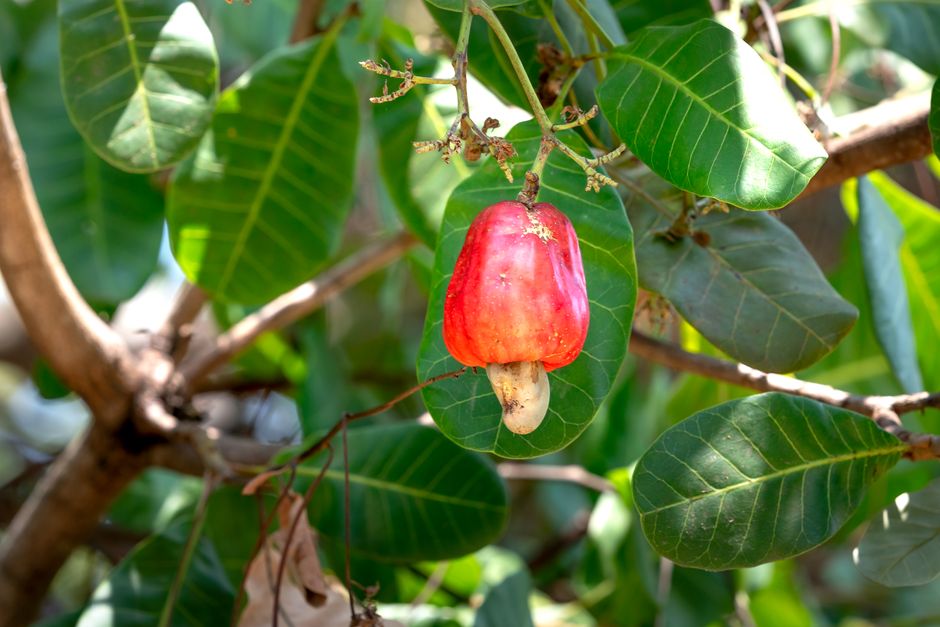
Table of Contents
- Key Takeaways
- The Truth About Cashews Growing in Their Peculiar Way
- Why Cashew Shells Are Never Sold to Consumers
- The Edible Cashew Apple: A Fruit Lost in Translation
- Cashew Cultivation: From Brazilian Native to Global Commodity
- Myths and Truths About Cashew Toxicity
- Frequently Asked Questions
- Sources
Did you know that cashews don’t grow the way you think they do? Most people have never seen how these kidney-shaped nuts appear in nature—and when they finally do, the sight is downright bizarre. The surprising truth about cashews growing is that the nut dangles outside what looks like a fruit, completely exposed, hanging like a strange botanical afterthought. This unusual arrangement makes the cashew one of the plant kingdom’s most interesting oddities.
Unlike almonds, walnuts, or peanuts, cashews follow rules all their own. What we casually toss into trail mix is actually a seed that grows in one of nature’s most unexpected configurations, challenging everything we assume about how nuts should develop.
Key Takeaways
- The cashew “nut” is actually a seed that grows outside and below a fleshy, pear-shaped structure called a cashew apple
- The cashew apple is the true fruit, while the nut hangs externally in a kidney-shaped shell
- Raw cashew shells contain toxic oils similar to poison ivy, which is why you never see cashews sold in their shells
- The cashew tree (Anacardium occidentale) is native to Brazil but now grows throughout tropical regions
- Cashew apples are edible and popular in some countries, though they rarely appear in international markets due to their perishability
- Processing cashews requires careful roasting or steaming to neutralize the shell’s toxic compounds
The Truth About Cashews Growing in Their Peculiar Way
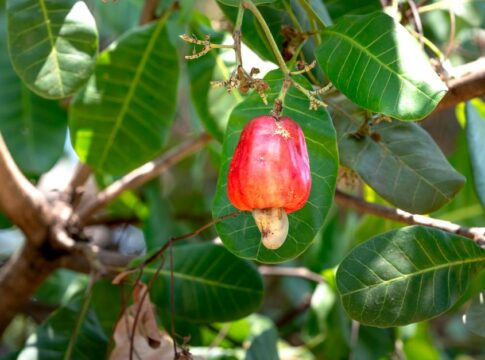
When you see a cashew growing on a tree, your brain takes a moment to process what you’re looking at. A bulbous, colorful structure—yellow, red, or orange—dangles from a branch. It resembles a small bell pepper or a misshapen pear. This is the cashew apple, and it’s technically the fruit’s swollen stem, called an accessory fruit.
But here’s where things get weird. Hanging below this fleshy apple, attached to its bottom, sits a hard, dark, kidney-shaped shell. That shell contains the cashew seed we eat. The entire arrangement looks backwards, as if nature installed the nut as an external appendage rather than tucking it safely inside like a sensible fruit would.
This outside-the-fruit configuration is nearly unique in the botanical world. While the cashew apple develops from the swollen flower stem (the receptacle), the actual nut develops from the ovary in the typical way—but it remains completely external. The cashew apple can grow to the size of a small apple or pear, dwarfing the nut that dangles beneath it.
Why Cashew Shells Are Never Sold to Consumers
Here’s an unknown fact that explains a common mystery: you can buy walnuts in shells, pecans in shells, even Brazil nuts in shells. But never cashews. The reason is genuinely dangerous.
The cashew shell contains urushiol, the same toxic oil found in poison ivy and poison oak. The space between the inner seed and outer shell holds this caustic, resinous liquid. Contact with raw cashew shells can cause severe skin reactions, blistering, and allergic responses. Some workers in cashew processing facilities have developed chronic dermatitis from repeated exposure.
This is why every cashew you’ve ever eaten has been carefully processed. The shells must be roasted or steamed to neutralize the toxic oils before the edible nut can be safely extracted. It’s a labor-intensive process that requires skill and caution. The cashew’s membership in the Anacardiaceae family—which includes poison ivy, poison sumac, and poison oak—suddenly makes perfect sense.
The Edible Cashew Apple: A Fruit Lost in Translation
While Western consumers obsess over the nut, people in cashew-growing regions have long enjoyed the cashew apple itself. In Brazil, India, and parts of Africa and Southeast Asia, these fruits are eaten fresh, juiced, fermented into alcoholic beverages, or made into jams and chutneys.
The cashew apple tastes sweet and slightly astringent, with a fibrous texture. It’s rich in vitamin C—containing significantly more than oranges by some measures. The flavor profile combines tropical sweetness with a tannic quality that leaves your mouth feeling slightly dry.
So why don’t we see cashew apples in grocery stores worldwide? They’re extremely perishable. The fruit bruises easily and begins fermenting within 24 hours of harvest. This short shelf life makes international shipping impractical. The apple also contains tannins that give it an astringent quality some find off-putting. Consequently, in many cashew-producing regions, the apples are simply discarded or left to rot—an enormous waste of potentially nutritious food.
Cashew Cultivation: From Brazilian Native to Global Commodity
The cashew tree originated in northeastern Brazil, where indigenous peoples harvested both the nut and apple long before European contact. Portuguese colonizers recognized the tree’s value and spread it to their other tropical colonies during the 16th century. The tree thrived in coastal India, East Africa, and Southeast Asia.
Today, the largest producers are Vietnam, India, and Côte d’Ivoire. Interestingly, the tree’s native Brazil has been eclipsed by these adopted homes. Cashew trees are remarkably hardy once established, tolerating poor soils, drought, and coastal conditions that would stress other crops. They’re often planted to prevent erosion in sandy, marginal lands.
The trees are evergreen and can grow quite large, reaching heights of 30 to 40 feet. They begin bearing fruit roughly three years after planting and can produce for decades. Each tree yields a modest harvest compared to other nut crops, which partly explains why cashews command premium prices.
Myths and Truths About Cashew Toxicity
Several myths surround cashew safety. Let’s separate trivia from truth:
| Myth | Truth |
|---|---|
| Raw cashews are poisonous | The shells are toxic, but properly processed “raw” cashews (which have been heat-treated) are safe |
| Cashews sold as “raw” are truly unprocessed | All commercial cashews have been heated to remove shell toxins; “raw” means unroasted after this step |
| You can safely crack cashew shells at home | Absolutely not recommended—the shell oil can cause severe skin burns and reactions |
| Eating too many cashews is dangerous | Cashews are safe in normal quantities; the nut itself contains no urushiol once properly processed |
The “raw” cashews sold in health food stores have indeed been processed to remove toxic oils. They’re called raw because they haven’t been roasted a second time for flavor. True, completely unprocessed cashews would be unsafe to handle or consume.
Frequently Asked Questions
Can you eat the cashew apple?
Yes, cashew apples are entirely edible and nutritious. They taste sweet with an astringent quality and are popular in cashew-growing regions, where they’re eaten fresh, juiced, or fermented. However, they spoil quickly and rarely appear in markets outside tropical areas where cashews are grown.
Why are cashews more expensive than other nuts?
Cashew processing is extremely labor-intensive and requires careful handling due to the toxic shell oils. Each nut must be individually extracted from its caustic shell, usually by hand. The trees also produce relatively modest yields compared to other nut crops, and the cashew apple’s perishability means only the nut can be commercially exported.
Are cashews really nuts or are they seeds?
Botanically speaking, cashews are seeds, not true nuts. A true nut is a hard-shelled fruit that doesn’t split open at maturity. The cashew is technically a drupe seed—the edible part is the seed inside the shell, which grows outside the accessory fruit (the cashew apple).
What happens to all the discarded cashew apples?
In many commercial operations, cashew apples are unfortunately wasted due to their perishability and the focus on nut production. However, some regions process them into juice, jam, or alcoholic beverages. In India, cashew apple juice is fermented into feni, a traditional spirit. Efforts are underway to develop better uses for this nutritious but underutilized fruit.
The next time you snack on cashews, picture that strange botanical arrangement: a colorful, fleshy apple with a toxic-shelled seed hanging below it like nature’s peculiar ornament. It’s a reminder that the familiar foods we take for granted often have fascinating, hidden stories growing in places most of us will never see.