
By TrivBits, History Desk — Published September 26, 2026

Table of Contents
- Key Takeaways
- Origins of the Wall China Visibility Myth
- What Astronauts Actually See
- The Science Behind Space Visibility
- Comparing Visibility of Historical Structures
- Why the Myth Persists
- Frequently Asked Questions
- Sources
For generations, people have repeated a compelling claim: the Great Wall of China is the only human-made structure visible from space. This “fact” appeared in textbooks, trivia books, and casual conversations worldwide. The wall china visibility myth has become one of history’s most persistent misconceptions, linking an ancient engineering marvel to modern space exploration in a way that feels almost poetic. But is it actually true?
The reality is far more nuanced than the myth suggests. This enduring tale connects us to both the ancient past of Chinese civilizations and the modern era of space travel, but the connection isn’t quite what most people think.
Key Takeaways
- The Great Wall of China is not visible from space with the naked eye under normal viewing conditions
- Astronauts have consistently debunked this myth from low Earth orbit, reporting difficulty seeing the structure
- The myth likely originated before actual space travel, based on speculation about the wall’s impressive length
- Many other human-made structures are equally or more visible from space than the Great Wall
- The wall’s historical significance as an ancient defensive structure spanning multiple dynasties remains genuine regardless of space visibility
- Camera equipment and specific lighting conditions can make the wall photographable from orbit, though not easily visible to astronauts
Origins of the Wall China Visibility Myth
The claim predates actual space exploration. References to the wall’s visibility from the moon or space appeared as early as the 1930s and 1940s, decades before humans actually ventured beyond Earth’s atmosphere. Writers and educators speculated about what might be visible from such heights, and the Great Wall seemed like a natural candidate.
Why did this particular structure capture imaginations? The wall stretches across vast distances through northern China—roughly 13,000 miles when all its branches and sections are measured. Built and rebuilt across multiple dynasties and centuries, it represented an almost incomprehensible human achievement. The sheer scale made it feel like something that must be visible from extraordinary distances.
The myth gained momentum through repetition. Once it appeared in educational materials, it became self-perpetuating. Teachers taught it to students. Authors included it in books. The “fact” spread globally, becoming accepted wisdom despite lacking verification from anyone who had actually been to space.
What Astronauts Actually See
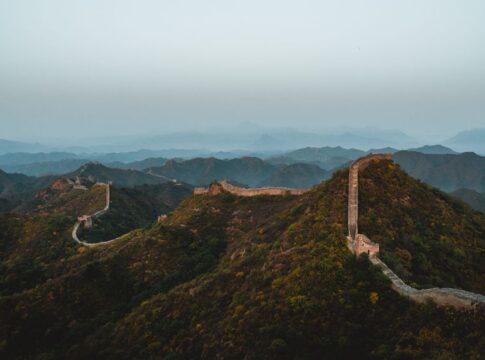
Real testimony from space travelers tells a different story. Astronauts orbiting Earth have repeatedly confirmed that spotting the Great Wall with unaided eyes is extremely difficult, if not impossible. The wall is certainly long, but it’s also narrow—typically about 15 to 30 feet wide. From hundreds of miles up, that width becomes virtually indistinguishable from the surrounding terrain.
Chinese astronaut Yang Liwei, who orbited Earth in 2003, specifically stated he could not see the Great Wall. His testimony carried particular weight given national pride in the historical structure. American astronauts have echoed similar observations. The wall’s colors blend with the natural landscape of mountains and valleys it traverses, making it nearly invisible against the earth’s surface.
What can astronauts see clearly? Cities at night create brilliant light displays. Large-scale agricultural patterns show up distinctly. Highway systems, airports, and major reservoirs are often visible. The Pyramids of Giza, despite being much smaller in total area than the Great Wall, are sometimes easier to spot because they contrast sharply with surrounding desert sands.
The Science Behind Space Visibility
Understanding why the myth fails requires basic optics and perspective. From the International Space Station, which orbits roughly 250 miles above Earth, objects need certain characteristics to be visible to the naked eye: sufficient size, contrast with surroundings, and favorable lighting conditions.
The Great Wall fails primarily on contrast and width. While incredibly long, its narrow profile means it occupies minimal visual area from orbit. The ancient building materials—primarily earth, stone, and brick—share colors with the natural environment. There’s no dramatic color difference to make the structure pop visually against mountains, forests, and plains.
Photographic evidence does exist of the wall from space, but this involves camera equipment with zoom capabilities and specific sun angles that create shadows. These photos confirm the wall’s existence and location, but they don’t support the visibility myth as originally stated—that astronauts can easily see it with their eyes alone.
Comparing Visibility of Historical Structures
| Structure | Era/Century | Visibility Factor | Why It Shows Up (or Doesn’t) |
|---|---|---|---|
| Great Wall of China | 7th century BC onward | Very Low | Narrow width, blends with terrain |
| Egyptian Pyramids | 26th century BC | Moderate | Strong contrast with desert sand |
| Modern City Grids | 19th-20th century | High | Geometric patterns, especially at night |
| Major Dams/Reservoirs | 20th century | High | Water creates distinct color contrast |
Why the Myth Persists
Despite clear evidence to the contrary, the Great Wall visibility myth continues circulating. Part of its staying power comes from the structure’s genuine historical importance. Built over centuries by various Chinese empires and dynasties, the wall represents extraordinary human determination and engineering prowess from the ancient past. People want to believe something so significant would be cosmically visible.
The myth also satisfies our desire for superlatives and unique facts. “The only human structure visible from space” sounds definitive and memorable. It’s the kind of trivia that gets shared at dinner parties and included in quiz games. Correcting it requires explaining nuance, which is less satisfying than a clean, simple claim.
Cultural pride plays a role too. The wall symbolizes Chinese civilization’s historical achievements. The visibility myth, while factually incorrect, elevated that symbol to cosmic significance. Debunking it can feel like diminishing the structure’s importance, even though the wall’s genuine historical and architectural significance needs no exaggeration.
Frequently Asked Questions
Can you see the Great Wall from the Moon?
Absolutely not. The Moon is roughly 240,000 miles from Earth. At that distance, even entire continents are difficult to distinguish clearly. No individual human-made structure is visible from the lunar surface, and the Great Wall is far too narrow to be seen from such an extreme distance, even with telescopic assistance.
What is actually the most visible human structure from space?
There’s no single answer, as visibility depends on altitude, time of day, and weather conditions. Cities at night, with their concentrated artificial lighting, are among the most obvious human signatures. Large-scale agricultural patterns, major highway networks, and significant reservoirs also show up clearly from orbit due to their size and contrast with surroundings.
How long and old is the Great Wall actually?
The wall system, including all branches and historical sections, measures approximately 13,000 miles. Construction began in the 7th century BC, with major building occurring during the Ming Dynasty from the 14th to 17th centuries. Different sections date to different eras, making it a multi-century project spanning various Chinese empires and dynasties throughout the ancient and medieval past.
Why did people believe the myth before space travel?
The claim emerged from speculation about the wall’s extraordinary length combined with limited understanding of how distance affects visibility. Before satellites and manned spaceflight, people could only guess what might be visible from space. The Great Wall’s fame and impressive scale made it seem like a logical candidate for such visibility, even though the physics didn’t support the assumption.
The Great Wall remains one of humanity’s most impressive engineering achievements from any historical era. Its significance doesn’t require embellishment with false claims about space visibility. The real story—of ancient civilizations organizing massive labor forces across centuries to build a defensive barrier through challenging terrain—is remarkable enough. Sometimes the truth, even when less sensational than the myth, proves far more interesting when we take time to understand it fully.