

By TrivBits, Staff Writer — Published September 13, 2026
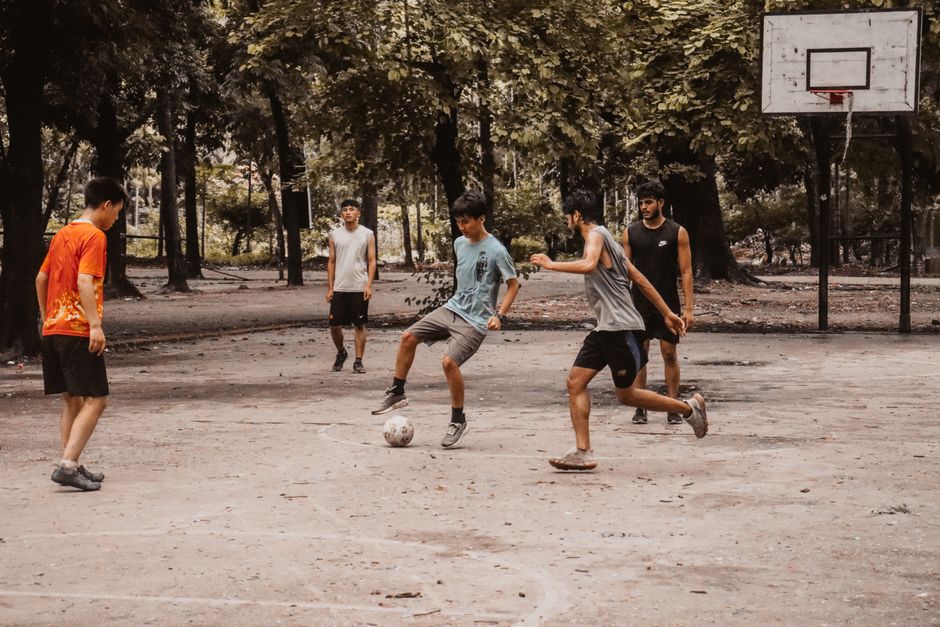
Table of Contents
- Key Takeaways
- Why Basketball Played With Soccer Balls Made Perfect Sense Initially
- The First “Real” Basketballs Were Hardly Better
- The 1929 Revolution: A Ball Designed for Basketball
- Interesting Facts About Basketball Equipment Evolution
- The Color Question: Why Orange Became Standard
- How Equipment Shaped Playing Styles
- Frequently Asked Questions
- Sources
When basketball was played with soccer balls for nearly four decades, the game looked remarkably different from what we know today. This surprising fact reveals how innovation in sports equipment can fundamentally transform athletic competition. Did you know that the iconic orange basketball—the one synonymous with the sport itself—didn’t exist when James Naismith invented the game in 1891?
The truth is that early basketball games used whatever spherical objects were available, primarily soccer balls. Players dribbled, passed, and shot these brown leather soccer balls into peach baskets, creating a slower, more deliberate style of play that would seem almost alien to modern fans.
Key Takeaways
- Basketball was invented in 1891 but didn’t have its own dedicated ball design until 1929
- Early games used soccer balls, which lacked the grip and bounce characteristics needed for optimal play
- The first basketball-specific ball featured laces similar to a football, making handling awkward and unpredictable
- The switch to laceless basketballs revolutionized dribbling and shooting techniques
- The distinctive orange color wasn’t introduced until the late 1950s
- Equipment evolution directly influenced how the game developed strategically and athletically
Why Basketball Played With Soccer Balls Made Perfect Sense Initially
James Naismith faced a practical problem in December 1891. The Canadian physical education instructor at the International YMCA Training School in Springfield, Massachusetts, needed to create an indoor game to keep students active during harsh New England winters. He had no budget for specialized equipment and no sporting goods manufacturers standing by to create custom balls.
Soccer balls were readily available. They were roughly the right size for handling and passing. The decision was pragmatic rather than ideal.
But soccer balls presented immediate challenges. Their external stitching and panels were designed for kicking, not handling. The leather surface became slippery when players’ hands perspired. Dribbling—which wasn’t even part of Naismith’s original rules—proved nearly impossible with any consistency. The ball’s seams created unpredictable bounces that frustrated players trying to develop reliable techniques.
The First “Real” Basketballs Were Hardly Better
Sporting goods companies eventually recognized basketball’s growing popularity and began manufacturing balls specifically for the sport in the early 1890s. These early attempts represented only marginal improvements over soccer balls. Manufacturers created larger balls with different panel configurations, but they retained one catastrophic design flaw: laces.
Like footballs of the era, early basketballs featured a laced closure where the leather panels came together. This raised seam created an uneven surface that made every aspect of ball handling unpredictable. Imagine trying to shoot a free throw when the ball might have laces facing toward you, away from you, or perpendicular to your shooting hand. Dribbling became a matter of luck as much as skill.
Players developed peculiar techniques to compensate. They learned to rotate the ball in their hands before shooting to find the smoothest surface. Dribbling remained rare because controlling the ball’s bounce was so difficult. The game emphasized passing and positioning rather than individual ball-handling skills.
The 1929 Revolution: A Ball Designed for Basketball
The year 1929 marked a turning point. Manufacturers introduced the first laceless basketball design, fundamentally changing what was possible on the court. The removal of laces created a uniform surface that bounced predictably and could be gripped consistently from any angle.
This single innovation transformed basketball strategy. Dribbling suddenly became reliable enough to be a primary skill. Players could drive to the basket with confidence. Ball-handling wizardry emerged as coaches realized athletes could now control the ball in ways previously impossible. The faster, more dynamic game we recognize today began to take shape.
The timing was significant. Basketball was spreading rapidly through colleges and professional leagues. Standardizing equipment allowed the sport to develop consistent rules and techniques that could be taught and replicated across different programs and regions.
Interesting Facts About Basketball Equipment Evolution
| Year | Innovation | Impact on Game |
|---|---|---|
| 1891-1929 | Soccer balls and laced basketballs | Limited dribbling; emphasis on passing |
| 1929 | Laceless basketball introduced | Enabled reliable dribbling and ball control |
| 1937 | Molded basketballs replace stitched panels | Improved durability and consistency |
| Late 1950s | Orange-colored balls adopted | Better visibility for players and spectators |
The Color Question: Why Orange Became Standard
Here’s another unknown trivia tidbit: basketballs weren’t always orange. For decades, they remained the natural brown color of leather. The shift to orange happened surprisingly late in the sport’s history, during the late 1950s.
Coach Paul “Tony” Hinkle of Butler University advocated for a more visible ball color. He believed that both players and spectators would benefit from a ball that stood out against the court and uniforms. The bright orange hue he championed became standard, though it took years for the color to be universally adopted at all levels of play.
This change might seem purely aesthetic, but visibility matters enormously in fast-paced sports. Players could track passes more easily. Spectators could follow the action better. Television broadcasts benefited immensely from the high-contrast orange ball.
How Equipment Shaped Playing Styles
The evolution from soccer balls to modern basketballs didn’t just change how the game was played—it determined which skills became valuable and which players succeeded. Early basketball favored tall players who could position themselves near the basket, since dribbling wasn’t reliable. Passing accuracy and teamwork dominated strategy.
Once laceless balls enabled consistent dribbling, smaller, quicker players found new opportunities. Guards became essential rather than secondary. The crossover dribble, behind-the-back pass, and other ball-handling techniques emerged because the equipment finally supported them. The sport became more athletic, more individual, and considerably faster.
This pattern—equipment driving evolution—appears throughout sports history. Tennis changed when rackets shifted from wood to graphite. Golf transformed with metal woods and multilayer balls. Basketball’s equipment revolution simply happened to take nearly forty years.
Frequently Asked Questions
When exactly did basketball stop using soccer balls?
While basketball-specific balls with laces were available from the 1890s onward, the transition away from soccer balls happened gradually through the early 1900s as the sport became more organized. However, the truly modern laceless basketball wasn’t introduced until 1929, marking the end of the sport’s primitive equipment era.
Did using soccer balls make the game slower?
Absolutely. Soccer balls made dribbling unreliable and difficult, so early basketball emphasized passing, positioning, and set shots. The pace was considerably slower, and individual ball-handling skills were far less important than in the modern game. Scores were typically much lower as a result.
Who invented the laceless basketball?
The laceless basketball was developed by sporting goods manufacturers in 1929 as the sport’s popularity grew and the limitations of laced balls became increasingly apparent. Multiple companies worked on improved designs during this period, making it difficult to credit a single inventor.
Are orange basketballs required in all leagues today?
While orange has become the standard color for most basketball leagues worldwide, rules vary by organization. The distinctive orange hue is preferred for visibility, but some leagues and tournaments permit alternative colors. Youth leagues sometimes use multicolored balls, and specialty events occasionally feature different designs.
The next time you watch a point guard execute a lightning-fast crossover or a player sink a three-pointer with perfect backspin, remember that these moves were literally impossible for the first four decades of basketball history. Sometimes the smallest changes—like removing laces from a ball—create the biggest revolutions in how we play.