
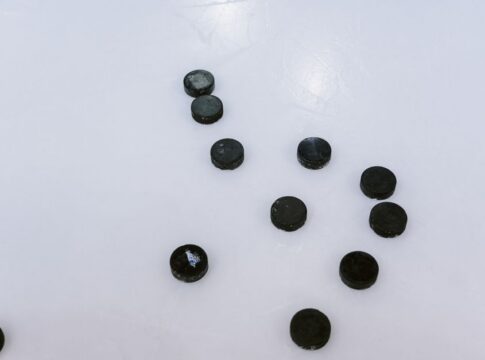
Why Hockey Pucks Are Frozen Before Games: The Physics
By Trivia Daily, Staff Writer — Published August 2, 2026
Table of Contents
- Key Takeaways
- Why Hockey Pucks Frozen Transform the Game
- The Temperature Sweet Spot
- The Bounce Test: Warm Versus Cold
- How Freezing Affects Puck Durability
- Common Myths About Frozen Pucks
- Frequently Asked Questions
Before every professional hockey game, pucks spend hours in a freezer at temperatures well below zero. This isn’t a quirky tradition or superstition—it’s essential physics in action. When hockey pucks are frozen, they become less bouncy, slide more predictably across the ice, and behave in ways that make the game faster and more controllable. What seems like a simple preparation step is actually a fascinating application of thermodynamics and material science that transforms how the game is played.
The discovery that frozen pucks perform better didn’t happen overnight. Players and officials noticed that warm pucks bounced erratically, sometimes flying off sticks unpredictably or hopping over the blade during crucial plays. Cooling the rubber changes its molecular structure in ways that are both surprising and scientifically measurable.
Key Takeaways
- Hockey pucks are frozen to reduce bounce and make them slide smoothly across the ice rather than tumbling or hopping.
- Freezing hardens the vulcanized rubber, making the puck less elastic and more predictable during play.
- Professional leagues typically freeze pucks to temperatures between -10°F and 20°F (-23°C to -7°C) before games.
- A warm puck can bounce up to 60% more than a frozen one, creating chaos on the ice.
- Frozen pucks also reduce the friction between the puck and ice, allowing for faster, smoother passes.
- Each NHL game uses dozens of pucks, all kept frozen and rotated throughout to maintain consistent performance.
Why Hockey Pucks Frozen Transform the Game
The science behind frozen pucks centers on rubber’s unique molecular properties. Hockey pucks are made from vulcanized rubber—a material treated with sulfur and heat to create cross-linked polymer chains. At room temperature, these chains have enough energy to move and flex, giving the rubber its characteristic bounce and elasticity. Cool that same rubber down, however, and those molecular chains lose kinetic energy. They become stiffer, more rigid, and far less prone to deformation.
This transformation is exactly what hockey needs. A bouncing puck is a player’s nightmare. Imagine trying to receive a pass when the puck might leap over your stick blade or carom off the ice at unpredictable angles. Frozen pucks stay flat. They glide rather than hop. Players can anticipate their movement with far greater accuracy, leading to crisper passes, better stickhandling, and more controlled shots.
The temperature change also affects friction. When a puck slides across ice, a thin layer of water forms beneath it due to pressure and friction—the same principle that makes ice skating possible. A frozen puck maintains this delicate balance more consistently than a warm one. The harder rubber surface creates less drag and more uniform contact with the ice, resulting in faster, straighter travel.
The Temperature Sweet Spot
Not all frozen temperatures work equally well. Too cold, and the puck becomes brittle and prone to shattering on impact with boards or sticks. Too warm, and you’re back to unpredictable bouncing. Professional leagues have settled on an optimal range through decades of trial and observation.
| Temperature Range | Puck Behavior | Game Impact |
|---|---|---|
| Room temperature (70°F/21°C) | Highly elastic, bounces excessively | Erratic play, poor control |
| Optimal frozen (0-20°F / -18 to -7°C) | Minimal bounce, smooth glide | Fast, predictable, professional-quality |
| Extremely cold (below -20°F / -29°C) | Brittle, risk of cracking | Potential equipment damage, inconsistent |
Teams typically store game pucks in freezers maintained at around 14-20°F (-10 to -7°C). Officials keep a supply on hand throughout the game, swapping out pucks that have warmed up from play. A single puck might only stay in play for a few minutes before it’s rotated out for a fresh frozen replacement.
The Bounce Test: Warm Versus Cold
You can demonstrate this principle yourself with a simple experiment. Drop a room-temperature hockey puck from shoulder height onto a hard surface. It will bounce noticeably, perhaps several inches high. Now freeze that same puck for a few hours and repeat the test. The difference is dramatic—the frozen puck barely bounces at all, making a dull thud instead of a lively rebound.
This difference matters enormously during gameplay. When players fire a puck at speeds exceeding 100 miles per hour, any tendency to bounce translates into wild unpredictability. A slap shot that hits the ice before reaching the goal needs to stay low and true. A bouncing puck might sail over the net or skip past a defender’s stick in ways that have nothing to do with skill and everything to do with thermodynamics.
How Freezing Affects Puck Durability
Interestingly, frozen pucks also last longer under the punishment of professional play. The hardened rubber resists the constant impacts, scrapes, and compressions that occur hundreds of times per game. Warm, softer rubber deforms more easily, developing flat spots, chips, and irregularities that affect performance.
This durability factor became especially important as the game evolved and shot speeds increased. Modern composite sticks generate incredible force. Without the protective effect of freezing, pucks would degrade rapidly, requiring even more frequent replacements. As it stands, NHL games already use dozens of pucks, each carefully managed to ensure consistent play.
Common Myths About Frozen Pucks
Several misconceptions persist about why pucks are frozen. Some believe it’s purely about speed—that frozen pucks travel faster. While they do glide more smoothly, the primary benefit is control and consistency, not raw velocity. Others think freezing makes pucks heavier. In reality, the weight change is negligible; a standard puck weighs between 5.5 and 6 ounces whether frozen or warm.
Another myth suggests that freezing protects players from injury. While a frozen puck might feel harder to the touch, the injury risk comes from velocity and impact location rather than temperature. A puck traveling at high speed will hurt regardless of whether it’s been in a freezer. The real safety benefit comes from predictability—players can better anticipate and react to pucks that behave consistently.
Frequently Asked Questions
How long do hockey pucks stay frozen during a game?
A puck typically stays cold enough for optimal performance for only a few minutes of active play. The friction from skating across ice and impacts with sticks generates heat, gradually warming the puck back toward room temperature. This is why officials rotate pucks frequently throughout the game.
Do all levels of hockey use frozen pucks?
Professional and high-level amateur leagues freeze pucks as standard practice, but recreational and youth leagues often don’t have the equipment or necessity. The difference is most noticeable at elite levels where shot speeds and precision matter most. Casual players may never notice the performance gap.
Can you freeze a puck too long?
Yes, over-freezing can make pucks brittle and prone to cracking or shattering on impact. Pucks stored at extremely low temperatures for extended periods may develop structural weaknesses. Proper storage maintains them at the optimal temperature range without excessive cold exposure.
What happens if a warm puck accidentally gets used in a professional game?
Officials would likely notice immediately due to erratic bouncing and replace it. Players can feel the difference in how the puck handles, and the unpredictable behavior would disrupt play. Modern games have strict puck management protocols to prevent this scenario.
The next time you watch a hockey game, pay attention to how smoothly pucks glide and how predictably they move across the ice. That consistency isn’t accidental—it’s the result of careful temperature management and an understanding of rubber physics that turns a simple disc into a precisely engineered piece of sports equipment. Science, it turns out, is as much a part of hockey as skill and speed.