
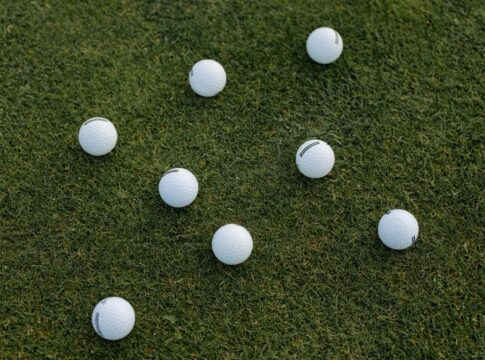
Why Golf Balls Have Dimples: The Aerodynamics Secret
By Trivia Daily, Staff Writer — Published July 30, 2026
Table of Contents
- Key Takeaways
- The Accidental Discovery of Golf Balls Dimples
- How Dimples Defeat Drag
- The Magnus Effect and Lift Generation
- Comparing Dimple Designs
- Why Other Sports Don’t Use Dimples
- Frequently Asked Questions
Every golf ball bristles with between 300 and 500 tiny dimples across its surface. These aren’t decorative—they’re precision-engineered features that let the ball fly nearly twice as far as a smooth sphere would. The story of golf balls dimples begins with a surprising discovery: early golfers noticed their old, battered balls actually flew better than shiny new ones. What seemed like wear and tear was actually an aerodynamic advantage waiting to be understood.
The science behind dimples reveals one of sport’s most elegant physics hacks. By creating controlled turbulence in the air flowing around the ball, dimples reduce drag and enhance lift in ways that seem almost counterintuitive. This fascinating interplay between surface texture and airflow transformed golf from a game of 150-yard drives into the modern sport where professionals routinely exceed 300 yards.
Key Takeaways
- Dimples allow golf balls to fly up to twice as far as smooth balls would travel under identical conditions.
- The dimpled surface creates a thin turbulent boundary layer of air that clings to the ball’s surface, reducing wake and drag.
- A smooth golf ball would travel roughly 130 yards with a professional swing, while a dimpled ball can exceed 290 yards.
- Most modern golf balls feature between 300 and 500 dimples, though the exact number varies by manufacturer and design philosophy.
- Golfers accidentally discovered the dimple effect in the mid-1800s when they noticed scuffed balls outperformed pristine ones.
- Dimples also create the Magnus effect, generating additional lift that keeps the ball airborne longer.
The Accidental Discovery of Golf Balls Dimples
Golf’s dimple revolution began not in a laboratory but on the links of Scotland. Players using gutta-percha balls—hard rubber spheres introduced in the mid-19th century—made an interesting observation. Their worn, nicked, and roughened balls consistently outperformed smooth new ones fresh from the manufacturer. Golfers being practical folk, some began intentionally roughening new balls with hammers and chisels.
This empirical discovery preceded scientific understanding by decades. Players didn’t know why textured surfaces worked better; they simply knew they did. Manufacturers eventually caught on, and by the early 1900s, balls were being produced with intentional surface patterns. Early designs featured raised bumps rather than indentations, but experimentation soon revealed that dimples—concave depressions—delivered superior performance.
The transition from accidental discovery to engineered precision took time. Modern dimple patterns are the result of extensive wind tunnel testing, computer modeling, and mathematical optimization. What began as golfers noticing their beat-up balls flew straighter has evolved into a sophisticated science involving fluid dynamics and materials engineering.
How Dimples Defeat Drag
The aerodynamic advantage comes down to managing airflow. When any object moves through air, it creates a wake—a turbulent region of low pressure behind it. This wake generates drag, the resistance that slows the object down. A smooth sphere creates a large, chaotic wake because the air flowing around it separates early from the surface, creating substantial drag.
Dimples change this equation dramatically. They create a thin layer of turbulent air that clings to the ball’s surface longer than smooth airflow would. This turbulent boundary layer follows the ball’s contours farther around the back side before separating. The result? A smaller wake, less drag, and a ball that slices through air with remarkable efficiency.
The numbers tell the story. A smooth golf ball experiences roughly twice the drag of a dimpled one at typical golf ball velocities. This translates directly to distance: what might be a 130-yard shot with a smooth ball becomes a 260-yard drive with dimples. For professional golfers generating high swing speeds, dimpled balls can travel even farther, regularly exceeding 290 yards on well-struck drives.
The Magnus Effect and Lift Generation
Dimples don’t just reduce drag—they also enhance lift. When a golf ball spins, it creates an asymmetric pressure distribution around its surface through the Magnus effect. The backspin imparted by a club face makes the ball’s bottom surface move faster relative to the air than the top surface. This velocity difference creates higher pressure below and lower pressure above, generating upward lift.
Dimples amplify this effect. The turbulent boundary layer they create interacts with the ball’s spin to produce stronger pressure differentials than a smooth surface would. This additional lift keeps the ball airborne longer, contributing significantly to total distance. A well-struck drive doesn’t just fly far—it stays in the air for several seconds, maximizing both range and hang time.
The optimal dimple pattern balances multiple competing factors: depth, diameter, edge sharpness, and overall coverage. Too shallow and they don’t generate enough turbulence. Too deep and they create excessive drag. Manufacturers guard their proprietary patterns closely, with each design representing years of research and testing.
Comparing Dimple Designs
| Design Feature | Typical Range | Effect on Performance |
|---|---|---|
| Number of Dimples | 300–500 | More dimples can mean better coverage but smaller individual size |
| Dimple Depth | 0.010 inches | Deeper dimples create more turbulence but may increase drag if too deep |
| Surface Coverage | 70–80% | Higher coverage generally improves aerodynamic efficiency |
| Pattern Shape | Spherical, hexagonal, hybrid | Different patterns optimize for distance, control, or flight stability |
Why Other Sports Don’t Use Dimples
The success of golf ball dimples raises an obvious question: why don’t other sports use them? The answer lies in the specific conditions under which dimples provide advantages. Golf balls travel at moderate speeds (typically 150–180 mph off the tee) and benefit from extended flight time. These conditions make dimples ideal.
Baseballs and cricket balls, by contrast, use raised stitches that create different aerodynamic effects suited to their sports. These seams allow pitchers and bowlers to manipulate flight paths through spin and orientation. Tennis balls use fuzzy fabric that creates drag, intentionally slowing the ball and making rallies possible. Each sport has evolved surface textures optimized for its unique requirements.
Even within golf, not all balls use identical dimple patterns. Balls designed for maximum distance feature different configurations than those optimized for control around greens. Some manufacturers experiment with non-circular dimple shapes—hexagons, pentagons, and other polygons—seeking marginal gains in specific performance categories.
Frequently Asked Questions
How many dimples does a regulation golf ball have?
Most golf balls have between 300 and 500 dimples, though there’s no regulatory requirement for a specific number. The exact count varies by manufacturer, with popular models ranging from 336 to 432 dimples depending on the pattern design and intended performance characteristics.
Can you play golf with a smooth ball?
Yes, but your drives would travel roughly half the distance of a dimpled ball. A smooth ball hit with a professional swing might travel only 130 yards compared to 260 yards or more for a dimpled ball under identical conditions, making the game significantly more difficult.
Who invented dimples on golf balls?
Dimples weren’t invented by a single person but evolved from golfers’ observations in the mid-1800s that worn, scuffed balls flew better than smooth ones. Manufacturers began intentionally adding surface textures in the early 1900s, gradually refining designs into the modern dimple patterns used today.
Do dimple patterns affect ball flight differently?
Yes, different dimple patterns, depths, and counts influence flight characteristics including distance, trajectory height, and spin rates. Manufacturers design specific patterns to optimize balls for different player needs, from maximum distance off the tee to enhanced control on approach shots.
The humble dimple transforms a simple sphere into an aerodynamic marvel, proving that sometimes the best solutions come from careful observation rather than pure theory. Next time you watch a golf ball soar 300 yards down a fairway, remember: you’re watching hundreds of tiny dimples working together to cheat the wind.