
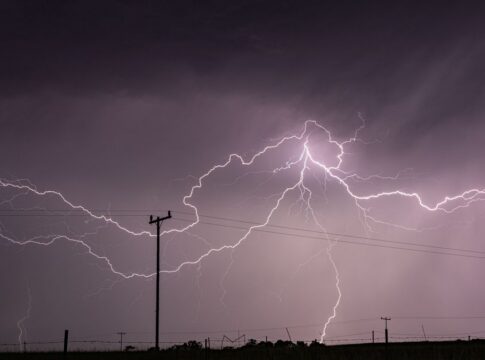
9 Bizarre Facts About Lightning You Never Knew
By Trivia Daily, Staff Writer — Published August 2, 2026
Table of Contents
- Key Takeaways
- The Bizarre Lightning Facts You Never Knew About Nature’s Electric Show
- Lightning Safety and Scientific Understanding
- Comparing Types of Lightning
- The Science Behind Thunder and Lightning
- Frequently Asked Questions
Lightning strikes Earth roughly 100 times every second, yet most of us know surprisingly little about this electrifying phenomenon. Beyond the spectacular light show and rumbling thunder, lightning harbors secrets that challenge common assumptions and reveal nature’s astonishing power. These bizarre lightning facts will transform how you view the next storm rolling across the sky.
From unexpected places lightning can strike to the strange effects it has on sand and human skin, prepare to discover trivia that’s both fascinating and scientifically sound. The stories behind lightning’s behavior are stranger than fiction.
Key Takeaways
- Lightning can strike the same location multiple times, with tall structures like the Empire State Building hit around 20-25 times annually.
- A single lightning bolt carries enough energy to toast 100,000 slices of bread, reaching temperatures five times hotter than the sun’s surface.
- Lightning creates glass sculptures called fulgurites when it strikes sand, fusing grains into hollow tubes that can extend several feet underground.
- Approximately 10% of lightning strike victims develop permanent, branching scar patterns on their skin called Lichtenberg figures.
- Positive lightning, which accounts for only 5% of strikes, carries up to ten times more current than typical negative lightning.
- Lightning regularly strikes upward from tall buildings and mountains toward storm clouds, not just downward from sky to ground.
The Bizarre Lightning Facts You Never Knew About Nature’s Electric Show
Lightning has fascinated and terrified humans for millennia, inspiring myths about angry gods and supernatural forces. Modern science has unveiled the electrical mechanisms behind thunderstorms, but many of lightning’s most interesting behaviors remain poorly understood by the general public. These facts explore the surprising, sometimes counterintuitive truths about one of nature’s most powerful displays.
Understanding lightning means challenging assumptions. The phrase “lightning never strikes twice” couldn’t be more wrong. Tall structures act like lightning magnets, with the Empire State Building struck dozens of times each year during storm season. Park rangers and meteorologists have documented individual trees struck repeatedly over time, their scarred bark telling the story of multiple encounters with millions of volts.
1. Lightning Is Five Times Hotter Than the Sun’s Surface
When lightning rips through the atmosphere, it superheats the air to approximately 30,000 Kelvin (53,540°F). For comparison, the surface of the sun reaches about 5,800 Kelvin. This extreme temperature causes the air to expand explosively, creating the shock wave we hear as thunder. The bolt itself lasts only a fraction of a second, but in that instant, it channels enough energy to power a 100-watt light bulb for more than three months. The intense heat explains why lightning can instantly vaporize water, split trees, and fuse sand into glass.
2. Sand Struck by Lightning Transforms Into Hollow Glass Tubes
When lightning hits sandy soil or beach sand, it creates natural glass sculptures called fulgurites. The electrical discharge melts the sand along its path, and as it cools rapidly, it forms hollow, tube-like structures. These fragile formations can extend several feet underground, branching like frozen lightning itself. Fulgurites preserve the exact path the lightning took through the sand. Scientists study them to understand lightning’s behavior, while collectors prize them for their otherworldly appearance. The inner surfaces are typically smooth glass, while the outer surfaces remain rough with fused sand grains.
3. Positive Lightning Strikes Are Rare but Extraordinarily Powerful
Most lightning carries a negative charge from cloud to ground, but roughly 5% of strikes are positive, originating from the upper regions of thunderstorms. Positive lightning can strike from clear blue sky up to 25 miles away from the storm itself, earning the nickname “bolts from the blue.” These strikes carry up to ten times more current than negative lightning and last significantly longer. They’re responsible for many unexplained fires and the majority of dangerous lightning-related incidents. The power of positive lightning explains why meteorologists warn that you can be struck even when storms appear distant.
4. Lightning Strikes Upward as Often as It Strikes Down
Contrary to popular belief, lightning doesn’t simply fall from clouds to earth. Upward lightning regularly initiates from tall structures, mountains, and towers, reaching toward the charged storm clouds above. High-speed cameras have revealed that what appears as a single flash is actually a complex back-and-forth exchange. A “stepped leader” descends from the cloud in stages, while “streamers” rise from the ground to meet it. Once they connect, the main discharge follows the ionized path. From very tall structures like communication towers and skyscrapers, upward lightning can account for the majority of strikes to those locations.
5. Lightning Victims Can Develop Permanent Branching Scars
Approximately 10% of people struck by lightning develop distinctive skin markings called Lichtenberg figures. These fernlike, branching patterns appear red or pink and trace the path electricity took across the skin. While many fade within days or weeks, some remain permanent. The patterns form when the electrical discharge ruptures capillaries beneath the skin. Named after German physicist Georg Christoph Lichtenberg who first studied electrical discharge patterns in the 18th century, these marks provide a visible record of the lightning’s path. They’re distinct from burns and represent a unique type of injury seen almost exclusively with lightning strikes.
6. Rubber Tires and Rubber Shoes Don’t Protect You From Lightning
The myth that rubber-soled shoes or car tires protect against lightning persists despite being thoroughly debunked. Lightning that has traveled miles through the air won’t be stopped by a half-inch of rubber. Cars do protect occupants during lightning storms, but not because of the tires. The metal frame of a vehicle acts as a Faraday cage, conducting the electrical charge around the exterior and into the ground, leaving the interior safe. The National Weather Service emphasizes that the safest place during a thunderstorm is inside a substantial building or a hard-topped metal vehicle with windows closed. Convertibles, golf carts, and vehicles with fiberglass shells offer no protection.
7. Lightning Produces Antimatter
In 2009, NASA‘s Fermi Gamma-ray Space Telescope detected gamma rays from thunderstorms that indicated the production of antimatter. When lightning occurs, it can accelerate electrons to nearly the speed of light. These high-energy electrons produce gamma rays, which can then create electron-positron pairs (the positron being the antimatter counterpart of the electron). The positrons quickly annihilate when they encounter regular electrons, producing additional gamma rays. This discovery revealed that thunderstorms are natural particle accelerators, creating antimatter right here in Earth’s atmosphere. The phenomenon occurs far more commonly than scientists previously imagined.
8. Ball Lightning Remains One of Science’s Great Mysteries
Witnesses have reported glowing, floating spheres of light during thunderstorms for centuries, but ball lightning remains poorly understood and rarely photographed. These luminous orbs reportedly range from golf ball to beach ball size, hover or drift slowly, and can last from seconds to minutes before fading or exploding. Unlike regular lightning, ball lightning can apparently pass through windows and even airplane fuselages. Scientists have proposed numerous theories involving plasma, microwave radiation, and chemical reactions, but no single explanation accounts for all reported characteristics. The rarity and unpredictability of ball lightning makes it extremely difficult to study, leaving it as one of atmospheric science’s most intriguing unsolved phenomena.
9. Volcanic Eruptions Create Their Own Lightning
Volcanic lightning, also called a “dirty thunderstorm,” occurs when lightning forms in the plume of ash and gases ejected during an eruption. The mechanism differs from regular thunderstorm lightning. As rock fragments, ash, and ice particles collide within the volcanic plume, they generate static electricity through friction. When the electrical charge becomes strong enough, it discharges as lightning. Photographs of volcanic eruptions show spectacular bolts streaking through the ash cloud, creating an apocalyptic scene. This phenomenon has been documented at eruptions worldwide, from Iceland’s Eyjafjallajökull to Japan’s Mount Sakurajima. Scientists study volcanic lightning to better understand both volcanic processes and the fundamental physics of electrical discharge.
Lightning Safety and Scientific Understanding
Understanding lightning’s behavior isn’t just fascinating trivia—it saves lives. The National Weather Service reports that lightning kills an average of 20 people annually in the United States and injures hundreds more. Most victims are struck while engaging in outdoor activities, often because they underestimate the distance from which lightning can strike.
The 30-30 rule provides a simple safety guideline: when you see lightning, count the seconds until you hear thunder. If that time is 30 seconds or less, seek shelter immediately. Lightning can strike from 10 miles away, so if you can hear thunder, you’re within striking distance. After the last thunder rumble, wait at least 30 minutes before resuming outdoor activities. This conservative approach accounts for the unpredictability of storm movement and the danger of trailing lightning strikes.
Comparing Types of Lightning
| Type | Frequency | Characteristics | Danger Level |
|---|---|---|---|
| Negative Cloud-to-Ground | ~95% of strikes | Standard lightning, moderate current, brief duration | High |
| Positive Cloud-to-Ground | ~5% of strikes | Extremely powerful, long duration, can strike far from storm | Very High |
| Cloud-to-Cloud | Most common overall | Occurs between or within clouds, creates sheet lightning | Low (to ground) |
| Upward Lightning | Common from tall structures | Initiates from ground upward, occurs on mountains and towers | High (to structures) |
The Science Behind Thunder and Lightning
Lightning and thunder are inseparable partners, but they’re often misunderstood. Thunder is simply the sound produced by lightning’s extreme heat. As the lightning bolt superheats the air to temperatures far exceeding the sun’s surface, the air expands faster than the speed of sound, creating a shock wave. This is thunder.
The rumbling quality of thunder comes from sound waves reflecting off clouds, hills, and buildings, as well as the fact that different parts of the lightning bolt are at varying distances from the listener. A nearby strike produces a sharp crack, while distant lightning creates a low rumble as the sound travels through the atmosphere.
Light travels much faster than sound—roughly 186,000 miles per second compared to sound’s 767 miles per hour at sea level. This explains why you see the flash before hearing the boom. By counting the seconds between flash and thunder, then dividing by five, you can estimate your distance from the strike in miles (or divide by three for kilometers). This simple calculation has helped countless people gauge storm proximity and make safety decisions.
Frequently Asked Questions
Can you really calculate how far away lightning is by counting seconds?
Yes, this method works because light reaches you almost instantly while sound travels much slower at about one mile every five seconds. Count the seconds between the flash and thunder, then divide by five to get the approximate distance in miles. If the count is 10 seconds, the lightning struck about two miles away.
Why does lightning appear to flicker or have multiple bolts?
A single lightning flash often consists of multiple strokes following the same ionized channel in rapid succession. High-speed cameras reveal that what appears as one flash may actually be three to four separate strokes occurring within fractions of a second. This creates the flickering appearance and explains why some lightning appears brighter than others.
Is it safe to shower or bathe during a thunderstorm?
No, this is genuinely dangerous. Lightning can travel through a building’s plumbing system because water and metal pipes conduct electricity. The National Weather Service recommends avoiding all water usage during thunderstorms, including showering, bathing, washing dishes, or washing hands. Wait until the storm has passed completely before using plumbing.
What should you do if caught outside during a lightning storm with no shelter available?
Avoid being the tallest object and stay away from isolated trees, water, and metal objects. Crouch low on the balls of your feet with feet together, minimizing ground contact while staying low. Never lie flat, as this increases your contact with the ground and potential ground current. The goal is to be as small a target as possible while minimizing ground contact if lightning strikes nearby.
Lightning continues to surprise researchers with new discoveries, from its role in creating antimatter to its complex interactions with volcanic ash. Each storm that rolls across the planet carries millions of volts of electricity, briefly connecting heaven and earth in one of nature’s most spectacular demonstrations of raw power. The next time you watch lightning dance across the sky, you’ll know you’re witnessing a phenomenon that’s simultaneously well-understood and deeply mysterious—a force that’s been shaping our planet since the atmosphere first formed billions of years ago.