










1 / 10 Questions
0 Points

What Type Of Pastry Are Cream Puffs Made From?

Puff

Shortcrust

Choux

Phyllo

Points won
0
Correct score
0%

More Questions

More Articles

The Truth About Cashews Growing Outside the Fruit

The Truth About Cashews Growing Outside the Fruit

By TrivBits, Staff Writer — Published August 21, 2026
The Truth About Cashews Growing Outside the Fruit — Food & Drink trivia by TrivBits

Table of Contents

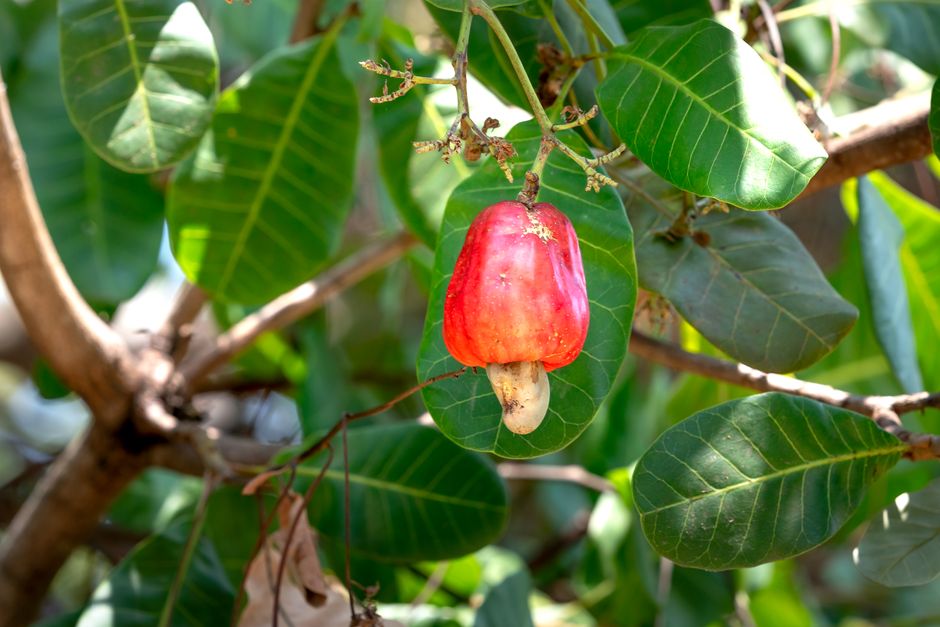
Did you know that cashews don't grow the way you think they do? Most people have never seen how these kidney-shaped nuts appear in nature—and when they finally do, the sight is downright bizarre. The surprising truth about cashews growing is that the nut dangles outside what looks like a fruit, completely exposed, hanging like a strange botanical afterthought. This unusual arrangement makes the cashew one of the plant kingdom's most interesting oddities.

Unlike almonds, walnuts, or peanuts, cashews follow rules all their own. What we casually toss into trail mix is actually a seed that grows in one of nature's most unexpected configurations, challenging everything we assume about how nuts should develop.

Key Takeaways

  • The cashew "nut" is actually a seed that grows outside and below a fleshy, pear-shaped structure called a cashew apple
  • The cashew apple is the true fruit, while the nut hangs externally in a kidney-shaped shell
  • Raw cashew shells contain toxic oils similar to poison ivy, which is why you never see cashews sold in their shells
  • The cashew tree (Anacardium occidentale) is native to Brazil but now grows throughout tropical regions
  • Cashew apples are edible and popular in some countries, though they rarely appear in international markets due to their perishability
  • Processing cashews requires careful roasting or steaming to neutralize the shell's toxic compounds

The Truth About Cashews Growing in Their Peculiar Way

When you see a cashew growing on a tree, your brain takes a moment to process what you're looking at. A bulbous, colorful structure—yellow, red, or orange—dangles from a branch. It resembles a small bell pepper or a misshapen pear. This is the cashew apple, and it's technically the fruit's swollen stem, called an accessory fruit.

But here's where things get weird. Hanging below this fleshy apple, attached to its bottom, sits a hard, dark, kidney-shaped shell. That shell contains the cashew seed we eat. The entire arrangement looks backwards, as if nature installed the nut as an external appendage rather than tucking it safely inside like a sensible fruit would.

This outside-the-fruit configuration is nearly unique in the botanical world. While the cashew apple develops from the swollen flower stem (the receptacle), the actual nut develops from the ovary in the typical way—but it remains completely external. The cashew apple can grow to the size of a small apple or pear, dwarfing the nut that dangles beneath it.

Why Cashew Shells Are Never Sold to Consumers

Here's an unknown fact that explains a common mystery: you can buy walnuts in shells, pecans in shells, even Brazil nuts in shells. But never cashews. The reason is genuinely dangerous.

The cashew shell contains urushiol, the same toxic oil found in poison ivy and poison oak. The space between the inner seed and outer shell holds this caustic, resinous liquid. Contact with raw cashew shells can cause severe skin reactions, blistering, and allergic responses. Some workers in cashew processing facilities have developed chronic dermatitis from repeated exposure.

This is why every cashew you've ever eaten has been carefully processed. The shells must be roasted or steamed to neutralize the toxic oils before the edible nut can be safely extracted. It's a labor-intensive process that requires skill and caution. The cashew's membership in the Anacardiaceae family—which includes poison ivy, poison sumac, and poison oak—suddenly makes perfect sense.

The Edible Cashew Apple: A Fruit Lost in Translation

While Western consumers obsess over the nut, people in cashew-growing regions have long enjoyed the cashew apple itself. In Brazil, India, and parts of Africa and Southeast Asia, these fruits are eaten fresh, juiced, fermented into alcoholic beverages, or made into jams and chutneys.

The cashew apple tastes sweet and slightly astringent, with a fibrous texture. It's rich in vitamin C—containing significantly more than oranges by some measures. The flavor profile combines tropical sweetness with a tannic quality that leaves your mouth feeling slightly dry.

So why don't we see cashew apples in grocery stores worldwide? They're extremely perishable. The fruit bruises easily and begins fermenting within 24 hours of harvest. This short shelf life makes international shipping impractical. The apple also contains tannins that give it an astringent quality some find off-putting. Consequently, in many cashew-producing regions, the apples are simply discarded or left to rot—an enormous waste of potentially nutritious food.

Cashew Cultivation: From Brazilian Native to Global Commodity

The cashew tree originated in northeastern Brazil, where indigenous peoples harvested both the nut and apple long before European contact. Portuguese colonizers recognized the tree's value and spread it to their other tropical colonies during the 16th century. The tree thrived in coastal India, East Africa, and Southeast Asia.

Today, the largest producers are Vietnam, India, and Côte d'Ivoire. Interestingly, the tree's native Brazil has been eclipsed by these adopted homes. Cashew trees are remarkably hardy once established, tolerating poor soils, drought, and coastal conditions that would stress other crops. They're often planted to prevent erosion in sandy, marginal lands.

The trees are evergreen and can grow quite large, reaching heights of 30 to 40 feet. They begin bearing fruit roughly three years after planting and can produce for decades. Each tree yields a modest harvest compared to other nut crops, which partly explains why cashews command premium prices.

Myths and Truths About Cashew Toxicity

Several myths surround cashew safety. Let's separate trivia from truth:

Myth Truth
Raw cashews are poisonous The shells are toxic, but properly processed "raw" cashews (which have been heat-treated) are safe
Cashews sold as "raw" are truly unprocessed All commercial cashews have been heated to remove shell toxins; "raw" means unroasted after this step
You can safely crack cashew shells at home Absolutely not recommended—the shell oil can cause severe skin burns and reactions
Eating too many cashews is dangerous Cashews are safe in normal quantities; the nut itself contains no urushiol once properly processed

The "raw" cashews sold in health food stores have indeed been processed to remove toxic oils. They're called raw because they haven't been roasted a second time for flavor. True, completely unprocessed cashews would be unsafe to handle or consume.

Frequently Asked Questions

Can you eat the cashew apple?

Yes, cashew apples are entirely edible and nutritious. They taste sweet with an astringent quality and are popular in cashew-growing regions, where they're eaten fresh, juiced, or fermented. However, they spoil quickly and rarely appear in markets outside tropical areas where cashews are grown.

Why are cashews more expensive than other nuts?

Cashew processing is extremely labor-intensive and requires careful handling due to the toxic shell oils. Each nut must be individually extracted from its caustic shell, usually by hand. The trees also produce relatively modest yields compared to other nut crops, and the cashew apple's perishability means only the nut can be commercially exported.

Are cashews really nuts or are they seeds?

Botanically speaking, cashews are seeds, not true nuts. A true nut is a hard-shelled fruit that doesn't split open at maturity. The cashew is technically a drupe seed—the edible part is the seed inside the shell, which grows outside the accessory fruit (the cashew apple).

What happens to all the discarded cashew apples?

In many commercial operations, cashew apples are unfortunately wasted due to their perishability and the focus on nut production. However, some regions process them into juice, jam, or alcoholic beverages. In India, cashew apple juice is fermented into feni, a traditional spirit. Efforts are underway to develop better uses for this nutritious but underutilized fruit.

The next time you snack on cashews, picture that strange botanical arrangement: a colorful, fleshy apple with a toxic-shelled seed hanging below it like nature's peculiar ornament. It's a reminder that the familiar foods we take for granted often have fascinating, hidden stories growing in places most of us will never see.

Sources

Top 10 Most Expensive Mistakes in Space Exploration

Top 10 Most Expensive Mistakes in Space Exploration

⏱️ 7 min read

Space exploration represents humanity's boldest venture into the unknown, pushing the boundaries of science, engineering, and human capability. However, this remarkable journey has come at an enormous cost—not just in terms of planned budgets, but through catastrophic failures, engineering oversights, and miscalculations that have cost billions of dollars and, tragically, human lives. These mistakes have shaped space programs worldwide, leading to improved safety protocols and more rigorous testing procedures. Understanding these costly errors provides valuable insights into the challenges of venturing beyond our planet and the importance of meticulous attention to detail in aerospace engineering.

Costly Failures That Changed Space History

1. The Mars Climate Orbiter Unit Conversion Error

In 1999, NASA lost the $327.6 million Mars Climate Orbiter due to one of the most embarrassing mistakes in space exploration history. The spacecraft disintegrated in Mars' atmosphere because one engineering team used imperial units (pound-seconds) while another used metric units (newton-seconds) for critical trajectory calculations. This simple unit conversion error caused the orbiter to approach Mars at an incorrect angle, coming within 57 kilometers of the surface instead of the planned 150 kilometers. The mission's failure became a textbook example of the importance of standardization and communication in complex engineering projects.

2. The Hubble Space Telescope Mirror Flaw

When the Hubble Space Telescope launched in 1990 at a cost of $2.5 billion, astronomers eagerly awaited the first images from space. Instead, they discovered the primary mirror had been ground to the wrong shape—off by just 2.2 micrometers, approximately one-fiftieth the width of a human hair. This microscopic error caused spherical aberration, making images blurry and nearly useless. The mistake occurred because of a miscalibrated testing instrument, and the error went undetected despite extensive pre-launch testing. NASA spent an additional $700 million on a repair mission in 1993 to install corrective optics, essentially giving the telescope "glasses" to fix its vision.

3. The Challenger Space Shuttle Disaster

The 1986 Challenger disaster remains one of the most tragic moments in space exploration, claiming the lives of seven astronauts and costing approximately $5.5 billion when accounting for the shuttle's value, investigation costs, and program delays. The disaster was caused by the failure of O-ring seals in the solid rocket boosters, which became brittle in the unusually cold temperatures on launch day. Engineers had warned about the temperature risks, but management pressure and schedule concerns led to the fatal decision to launch. The tragedy resulted in a 32-month suspension of the shuttle program and comprehensive safety reforms across NASA.

4. The Columbia Space Shuttle Breakup

Seventeen years after Challenger, the Columbia disaster in 2003 killed seven more astronauts and cost an estimated $13 billion, including the shuttle's replacement value and investigation expenses. A piece of foam insulation broke off from the external tank during launch and struck Columbia's wing, creating a breach in the thermal protection system. Upon re-entry, superheated gases entered the wing structure, causing the shuttle to disintegrate over Texas and Louisiana. The accident revealed systemic problems in NASA's safety culture, including normalization of deviance where foam strikes had become accepted as routine rather than dangerous anomalies.

5. The Soviet N1 Rocket Failures

The Soviet Union's attempt to reach the Moon centered on the N1 rocket, which failed spectacularly in all four attempted launches between 1969 and 1972. The most catastrophic failure occurred on July 3, 1969, when the first stage exploded just seconds after liftoff, creating one of the largest non-nuclear explosions in human history and destroying the launch pad. The program's estimated cost reached $10-15 billion in current dollars. The N1's design flaws included having 30 first-stage engines that were never tested together before flight due to lack of adequate test facilities. The program's cancellation effectively ended Soviet hopes of landing cosmonauts on the Moon.

6. The Mars Polar Lander Communication Loss

Just months after the Mars Climate Orbiter failure, NASA lost contact with the $165 million Mars Polar Lander in December 1999. Investigations concluded that a software flaw likely caused the spacecraft's descent engines to shut off prematurely when the landing legs deployed, creating a spurious touchdown signal. The lander probably crashed into Mars' surface at high speed. Additionally, the mission included two Deep Space 2 probes worth $30 million that also failed. The consecutive Mars mission failures in 1999 cost NASA nearly $500 million and forced a comprehensive review of the agency's "faster, better, cheaper" philosophy.

7. The Phobos-Grunt Mission Failure

Russia's ambitious Phobos-Grunt mission, designed to collect samples from Mars' moon Phobos, became one of the country's most expensive space failures when it malfunctioned in 2011. The $170 million spacecraft failed to leave Earth orbit due to a computer malfunction in its propulsion system. After weeks of unsuccessful recovery attempts, Phobos-Grunt fell back to Earth in January 2012, disintegrating over the Pacific Ocean. The failure was attributed to inadequate testing and possible cosmic radiation damage to microchips. The loss represented more than a decade of development work and dealt a significant blow to Russia's planetary exploration ambitions.

8. The Space Shuttle Endeavour Construction After Challenger

Following the Challenger disaster, NASA built the Space Shuttle Endeavour as a replacement, but at an extraordinary cost of $2.2 billion—significantly more than originally planned for shuttle construction. While not technically a mistake in the traditional sense, the need to build a replacement shuttle represented the extended financial consequences of the Challenger tragedy. The construction utilized spare parts from the other shuttles but required extensive additional funding and resources. This expense highlighted how a single catastrophic failure's costs ripple far beyond the immediate disaster, affecting program budgets for years.

9. The NOAA-19 Satellite Drop

In 2003, a Lockheed Martin team was performing maintenance on the NOAA-19 weather satellite when they failed to verify that support equipment was properly attached. The $135 million satellite fell over and crashed onto the factory floor, causing extensive damage. The accident occurred because technicians removed critical support bolts without proper documentation or communication during a shift change. The satellite required two years of repairs at a cost of $135 million—essentially doubling the project's price tag. This incident emphasized the importance of proper procedures and documentation even during routine maintenance operations.

10. The Ariane 5 Flight 501 Software Failure

The European Space Agency's Ariane 5 rocket exploded just 37 seconds after its maiden flight in 1996, destroying four scientific satellites worth $500 million combined. The cause was a software error: code reused from the Ariane 4 rocket couldn't handle the Ariane 5's faster acceleration, causing a data conversion overflow. The inertial reference system shut down, and incorrect guidance signals caused the rocket to veer off course, triggering its self-destruct mechanism. The disaster was particularly frustrating because the problematic code wasn't even necessary after liftoff. This failure became a classic case study in software engineering about the dangers of reusing code without thorough verification in new contexts.

Lessons Learned From Billion-Dollar Failures

These ten catastrophic mistakes collectively cost tens of billions of dollars and claimed fourteen lives in the Challenger and Columbia disasters alone. However, they've also driven profound improvements in space exploration practices. Modern space programs now emphasize rigorous testing protocols, clear communication standards, safety culture over schedule pressure, and learning from failures rather than hiding them. Unit standardization, software verification processes, and quality control procedures have all been strengthened as direct results of these expensive lessons. While the costs were enormous, the knowledge gained has made space exploration safer and more reliable, ensuring that these mistakes—and the lives lost—were not in vain. As humanity continues reaching for the stars, these historical failures serve as sobering reminders that success in space requires unwavering attention to detail, robust engineering practices, and a culture that prioritizes safety above all else.