
By TrivBits, History Desk — Published October 8, 2026
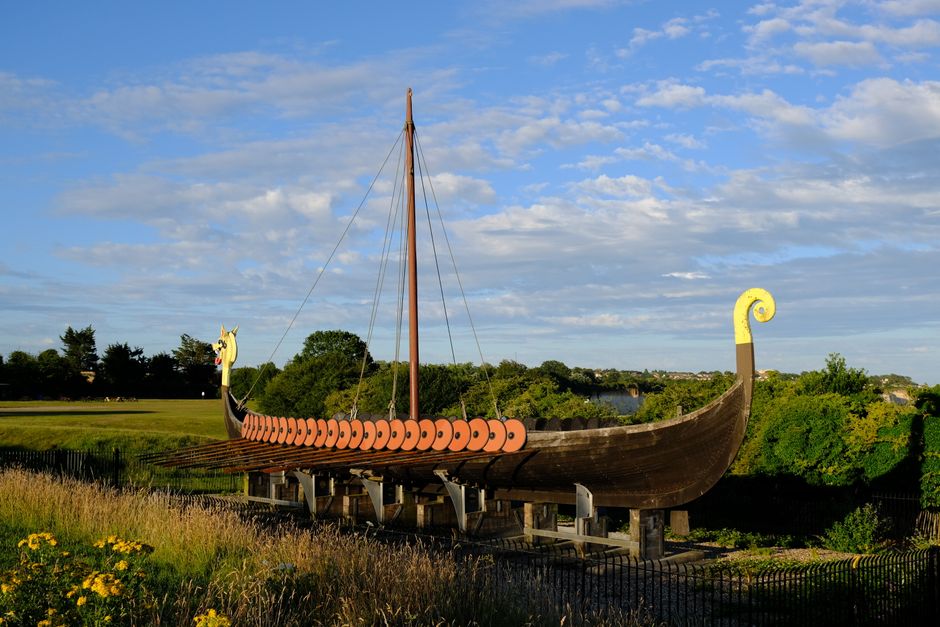
Table of Contents
- Key Takeaways
- The Vikings Reached America: Evidence From L’Anse aux Meadows
- The Sagas That Told the Truth
- Why Did the Vikings Abandon America?
- Comparing Norse and Columbian Voyages
- The Broader Historical Context
- Frequently Asked Questions
- Sources
For centuries, schoolchildren learned that Christopher Columbus “discovered” America in 1492. But this historical narrative overlooks a remarkable truth: Norse explorers had already set foot on North American soil around the year 1000 CE. The vikings reached america roughly five centuries before Columbus ever set sail, establishing a brief settlement in what is now Newfoundland, Canada. This ancient achievement represents one of the most fascinating chapters in the story of early exploration and contact between civilizations.
The evidence for this Norse presence isn’t just legend or saga. Archaeologists have uncovered physical proof that rewrites our understanding of trans-Atlantic contact in the medieval era.
Key Takeaways
- Norse Vikings established a settlement at L’Anse aux Meadows in Newfoundland around 1000 CE, approximately 500 years before Columbus reached the Caribbean.
- The site was discovered in 1960 by archaeologists Helge and Anne Stine Ingstad and remains the only confirmed Norse settlement in North America.
- Viking sagas, once dismissed as pure mythology, contained accurate geographical descriptions that helped researchers locate the actual settlement.
- The Norse called the lands they explored Vinland, Markland, and Helluland, referring to different regions along the North Atlantic coast.
- The Viking settlement in North America was short-lived, lasting only a few years before being abandoned.
- This historical discovery demonstrates that trans-Atlantic contact occurred far earlier than previously believed in Western academic history.
The Vikings Reached America: Evidence From L’Anse aux Meadows
The breakthrough came in 1960 when Norwegian explorer Helge Ingstad and his wife, archaeologist Anne Stine Ingstad, discovered the remains of a Norse settlement at L’Anse aux Meadows on the northern tip of Newfoundland. The site contained unmistakable evidence of Viking occupation: Norse-style turf buildings, a forge for working iron, and artifacts including a bronze cloak pin and iron boat nails.
What makes this discovery so compelling? The construction techniques matched those found in Norse Greenland and Iceland from the same period. The buildings featured thick turf walls built over wooden frames, exactly as Vikings constructed their dwellings in the North Atlantic. Eight complete structures were identified, including dwellings and workshops capable of housing between 70 and 90 people.
Radiocarbon dating placed the settlement firmly around 1000 CE. This wasn’t speculation or wishful thinking. The physical evidence was undeniable, earning the site UNESCO World Heritage status in 1978.
The Sagas That Told the Truth
Long before archaeological evidence emerged, Norse sagas spoke of voyages to lands west of Greenland. The “Saga of Erik the Red” and the “Saga of the Greenlanders” described explorations led by Leif Erikson and other Norse adventurers who encountered new territories across the ocean.
For generations, historians treated these sagas as entertaining fiction. Medieval tales often blended fact with fantasy, making it difficult to separate reality from embellishment. But the sagas contained surprisingly accurate geographical details: descriptions of coastlines, forests, and native populations that aligned with actual North American geography.
The texts mentioned three distinct regions. Helluland, meaning “stone slab land,” likely referred to Baffin Island with its flat rock formations. Markland, or “forest land,” probably described the heavily wooded coast of Labrador. Vinland, the most famous of the three, remains debated but almost certainly included the Newfoundland area where L’Anse aux Meadows stood.
Why Did the Vikings Abandon America?
If the Norse reached North America first, why didn’t they stay? Why did this empire of seafaring warriors fail to establish a lasting presence in a land rich with resources?
Distance played a crucial role. The journey from Greenland to Newfoundland covered hundreds of miles of dangerous open ocean. Supply lines stretched impossibly thin across the North Atlantic. Unlike the relatively short hops between Norway, Iceland, and Greenland, maintaining regular contact with Vinland proved unsustainable for a medieval civilization with limited resources.
The sagas also hint at conflicts with indigenous peoples, whom the Norse called “Skraelings.” These encounters sometimes turned violent. Outnumbered and far from reinforcements, the small Norse groups couldn’t establish the military dominance they might have achieved closer to home.
Climate matters too. The Medieval Warm Period that made Norse expansion possible began cooling. Harsher conditions made the already difficult Atlantic crossing even more treacherous. The Greenland colonies themselves eventually failed as temperatures dropped in subsequent centuries.
Comparing Norse and Columbian Voyages
| Aspect | Norse Voyages (circa 1000 CE) | Columbus Voyage (1492) |
|---|---|---|
| Starting Point | Greenland/Iceland | Spain |
| Landing Location | Newfoundland (North America) | Caribbean Islands |
| Duration of Settlement | Few years | Permanent colonization |
| Historical Impact | Limited; no lasting European presence | Triggered widespread European exploration and colonization |
| Navigation Method | Coastal sailing, knowledge of currents | Open ocean crossing with compass and celestial navigation |
| Documentation | Oral sagas written down later | Extensive written records and maps |
The Broader Historical Context
The Norse achievement fits into a larger pattern of medieval Norse expansion. During the Viking Age, roughly spanning the 8th through 11th centuries, Scandinavian seafarers spread across Europe and beyond. They founded kingdoms in England and Ireland. They traded with the Byzantine Empire. They settled Iceland starting around 870 CE and reached Greenland by 985 CE.
Each stepping stone brought them farther west. From Norway to the Shetland Islands. From the Shetlands to Iceland. From Iceland to Greenland. From Greenland, the North American coast lay tantalizingly close, just a few hundred miles across the Davis Strait.
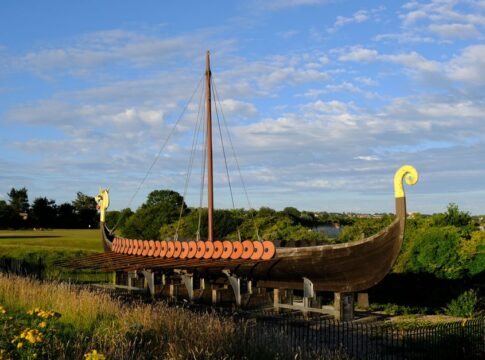
This wasn’t random wandering. The Norse possessed sophisticated ship-building technology and navigational knowledge. Their knarrs, sturdy cargo vessels, could carry families, livestock, and supplies across open ocean. They understood ocean currents, recognized landmarks, and passed geographic knowledge through generations.
The discovery of North America represented the westernmost extent of this expansion—the furthest reach of a civilization that had pushed the boundaries of the known world throughout the medieval era.
Frequently Asked Questions
Did Vikings actually live in North America?
Yes, archaeological evidence confirms that Norse Vikings established a settlement at L’Anse aux Meadows in Newfoundland around 1000 CE. However, the settlement was occupied for only a few years, not permanently. The site served as a base camp for exploration and possibly for processing resources like timber before the Norse abandoned it and returned to Greenland.
Who was the first Viking to reach America?
According to Norse sagas, Leif Erikson, son of Erik the Red, led the expedition that established the settlement in Vinland around 1000 CE. Some accounts suggest that Bjarni Herjólfsson may have sighted North American shores earlier while blown off course, but Leif Erikson is credited with the first intentional landing and exploration.
Why isn’t Viking discovery of America more widely known?
The Norse presence left no lasting settlements or significant historical impact on the Americas. Their voyages were recorded only in sagas that were long dismissed as mythology. Physical archaeological proof wasn’t discovered until 1960, and even then, it took time for this knowledge to spread through educational systems. Columbus’s voyages, by contrast, led to immediate and permanent European colonization with extensive documentation.
What does “Vinland” mean and where was it located?
Vinland translates roughly as “wine land” or possibly “meadow land,” depending on interpretation of the Old Norse. The exact extent of Vinland remains debated among scholars, but it certainly included the area around L’Anse aux Meadows in Newfoundland. Some researchers believe the Norse explored farther south along the North American coast, but L’Anse aux Meadows remains the only confirmed Norse archaeological site in North America.