
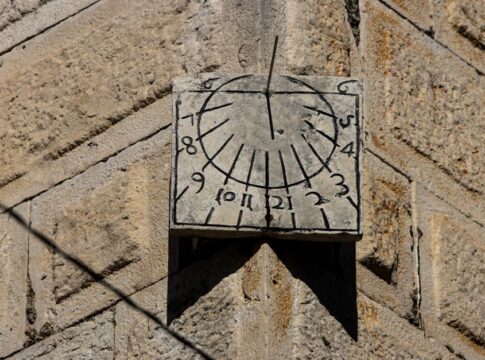
Why Clocks Run Clockwise: The Sundial History Explained
By Trivia Daily, History Desk — Published July 31, 2026
Table of Contents
- Key Takeaways
- How Sundials Shaped Our Clocks and the Clockwise Convention
- The Northern Hemisphere Advantage in Timekeeping History
- From Shadow to Mechanism: The Evolution of Timekeeping
- Comparing Timekeeping Methods Across History
- Why We Still Use Clockwise in the Digital Age
- Frequently Asked Questions
Every time you glance at a clock, you’re witnessing a convention so ingrained that it seems inevitable. But why do clocks move clockwise? The answer lies not in arbitrary choice but in ancient history. The direction we now take for granted—right, down, left, up—mirrors the shadow cast by sundials in the Northern Hemisphere, where early civilizations developed timekeeping. Before mechanical clocks existed, sundials tracked the sun’s journey across the sky, and their shadow’s movement became the template for every clock face that followed.
This connection between clocks, clockwise motion, and the sundial reveals how deeply our modern world remains tethered to innovations from the distant past. The story spans millennia and multiple civilizations, each contributing to humanity’s quest to measure time.
Key Takeaways
- Clockwise motion directly mimics the shadow movement on sundials used in the Northern Hemisphere, where most early clock-making civilizations developed.
- Ancient Egyptians created some of the earliest known sundials around 1500 BCE, dividing daylight into measurable segments.
- Mechanical clocks emerged in medieval Europe during the 13th and 14th centuries, adopting the familiar sundial shadow direction.
- In the Southern Hemisphere, sundial shadows move counterclockwise, but Northern Hemisphere conventions dominated global clockmaking standards.
- The term “clockwise” didn’t exist until clocks themselves became common; before that, people simply described the direction as following the sun’s path.
- Early water clocks and hourglasses didn’t have rotating hands, making mechanical clocks the first timekeepers to need a directional standard.
How Sundials Shaped Our Clocks and the Clockwise Convention
Sundials represent humanity’s first portable, reliable timekeeping devices. These instruments work through elegant simplicity: a raised piece called a gnomon casts a shadow onto a marked surface. As Earth rotates and the sun appears to move across the sky, the shadow traces a predictable arc. In the Northern Hemisphere—home to ancient Egypt, Mesopotamia, Greece, Rome, and later medieval Europe—this shadow sweeps from left to right in a curved path.
Egyptian sundials from over three millennia ago divided daylight into twelve segments, an arbitrary but enduring choice that gave us our twelve-hour system. Greeks and Romans refined sundial technology, creating portable versions and hemispherical designs that improved accuracy. By the time mechanical clocks appeared in European monasteries and town squares during the medieval era, the sundial’s visual language was deeply embedded in how people understood time’s passage.
When clockmakers in the 13th and 14th centuries designed rotating hands for their new mechanical marvels, they faced a choice: which direction should the hands turn? The answer was obvious to anyone familiar with sundials. They replicated the shadow’s familiar path—the same right-sweeping motion that had marked hours for countless generations. This wasn’t innovation but translation, converting the sun’s ancient dance into gears and escapements.
The Northern Hemisphere Advantage in Timekeeping History
Geography played a crucial role in establishing clockwise as the global standard. The civilizations that pioneered mechanical clockmaking—primarily in Italy, Germany, France, and England—all lay well north of the equator. In these regions, sundials had been the dominant timekeeping technology for over two thousand years before mechanical clocks arrived.
Had clock technology emerged first in the Southern Hemisphere, we might all be checking counterclockwise timepieces today. Below the equator, sundial shadows trace the opposite path, moving from right to left. But the empire-building nations of Europe, with their sundial traditions and early industrial capabilities, set the manufacturing standards that spread worldwide through colonization and trade networks.
Even cultures with their own rich timekeeping traditions—Chinese water clocks, Islamic astronomical instruments, Indian sundial variants—eventually adopted the European mechanical clock design when it proved more accurate and convenient. The clockwise convention came along with the technology, becoming universal not through any natural law but through historical circumstance and technological dominance.
From Shadow to Mechanism: The Evolution of Timekeeping
The journey from sundial to mechanical clock wasn’t instantaneous. Several intermediate technologies bridged the gap, each with limitations that eventually made rotating clock hands necessary.
Water clocks, or clepsydras, measured time through liquid flow. Ancient civilizations from China to Greece used these devices, especially useful at night or indoors where sundials failed. Hourglasses relied on sand trickling through narrow openings. Neither technology required directional conventions—they simply indicated elapsed time through changing water levels or sand positions.
Mechanical clocks changed everything. These devices, driven by falling weights and regulated by escapement mechanisms, could run continuously and display time on a circular face. The circular design itself echoed the sun’s apparent daily rotation, and the hands needed to move in some consistent direction. Choosing the sundial’s familiar path made intuitive sense to medieval Europeans who had internalized that rightward sweep as time’s natural movement.
Comparing Timekeeping Methods Across History
| Timekeeping Device | Era of Primary Use | Key Advantage | Major Limitation |
|---|---|---|---|
| Sundial | 1500 BCE–1600s CE | No moving parts, reliable in sunlight | Useless at night or in cloudy weather |
| Water Clock | 1400 BCE–1500s CE | Functions indoors and at night | Requires refilling, affected by temperature |
| Hourglass | 800 CE–1800s CE | Portable, consistent intervals | Must be manually flipped, measures fixed periods |
| Mechanical Clock | 1300s CE–present | Continuous operation, increasing accuracy | Required maintenance, initially expensive |
Why We Still Use Clockwise in the Digital Age
Digital displays don’t need directional conventions. Numbers simply change, no hands required. Yet analog clock faces persist on walls, wrists, and smartphone widgets. The clockwise direction remains so fundamental that we use it as a universal descriptor: turning a screw clockwise tightens it, storm systems rotate counterclockwise in the Northern Hemisphere, and countless mechanisms follow or reference this standard.
This persistence demonstrates how deeply historical choices embed themselves in human culture. Once a convention proves useful and spreads widely enough, changing it requires extraordinary justification. The clockwise direction isn’t superior to its opposite—it’s simply what we know, taught to children alongside reading and counting, as natural-seeming as the alphabet’s arbitrary order.
Some modern designers have created counterclockwise clocks as artistic statements or conversation pieces. These novelties prove unsettling precisely because they violate our trained expectations. We’ve internalized the sundial’s Northern Hemisphere shadow path so thoroughly that reversing it feels fundamentally wrong, even though it’s merely unfamiliar.
Frequently Asked Questions
Do clocks in the Southern Hemisphere run counterclockwise?
No, clocks worldwide run clockwise regardless of hemisphere. Although Southern Hemisphere sundials cast shadows that move counterclockwise, the global clockmaking industry standardized on the Northern Hemisphere convention, and that standard spread everywhere through trade and colonization.
When was the term “clockwise” first used?
The term “clockwise” emerged only after mechanical clocks became common enough to serve as a reference point, likely in the 16th or 17th century. Before clocks, people would have described the direction as “sunwise” or following the sun’s path across the sky.
Did any civilization create counterclockwise mechanical clocks?
No evidence exists of any culture mass-producing counterclockwise mechanical clocks. By the time mechanical clock technology spread globally, European designs had already established the standard, and practical considerations favored uniformity over regional variation.
How accurate were early sundials compared to mechanical clocks?
Sundials could be quite precise for their time, accurate to within about 15 minutes under ideal conditions. Early mechanical clocks from the 14th century were initially less accurate, sometimes gaining or losing an hour per day, but they improved rapidly and eventually far surpassed sundial precision.
The next time you watch a clock’s second hand sweep around its face, you’re seeing an echo of shadows cast thousands of years ago in ancient Egypt and Mesopotamia. That simple rightward motion connects us to every civilization that looked skyward and wondered how to capture time’s passage—a reminder that even our most modern conventions carry the fingerprints of the distant past.