
7 Surprising Facts About the Great Wall of China’s Length
By TrivBits, History Desk — Published August 12, 2026
Table of Contents
- Key Takeaways
- Understanding the Wall China Length Through Dynasty Construction
- The 2012 Archaeological Survey That Rewrote History Books
- Comparing Great Wall Measurements Across Dynasties
- Frequently Asked Questions
When you picture the Great Wall of China, you probably imagine a single, unbroken stone barrier snaking across mountaintops. The reality of the wall China length measurements reveals something far more complex and fascinating. This ancient marvel isn’t one continuous structure but a network of walls, trenches, and natural barriers built across multiple dynasties spanning over two millennia. The numbers associated with its true extent might surprise even history enthusiasts who think they know this iconic monument.
Recent archaeological surveys have dramatically changed our understanding of how long the Great Wall actually is. What generations learned in textbooks barely scratches the surface of this monumental achievement by one of history’s greatest civilizations.
Key Takeaways
- The official total length of all Great Wall sections combined is approximately 13,171 miles, not the commonly cited 5,500 miles
- The wall includes natural defensive barriers like rivers and mountain ridges counted in its total measurement
- Multiple dynasties built separate wall systems that rarely connected, creating overlapping networks rather than one continuous structure
- Some sections of the ancient fortification have completely disappeared due to erosion, agriculture, and urban development
- The Ming Dynasty walls represent only about 5,500 miles of the total historical construction
- Measurements include trenches, moats, and natural defensive features, not just stone and brick walls
Understanding the Wall China Length Through Dynasty Construction
The confusion about the Great Wall’s true dimensions stems from a fundamental misunderstanding. There isn’t just one Great Wall. Different Chinese dynasties built their own defensive systems over roughly 2,300 years, from the 7th century BC through the 17th century AD. The Qin Dynasty connected earlier state walls around 221 BC, but that empire’s wall followed a different route than the famous Ming Dynasty walls most tourists visit today.
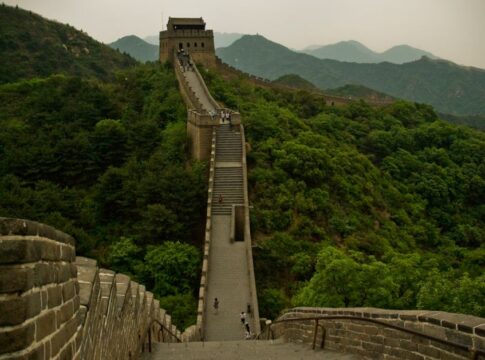
Each era built according to its own strategic needs. The Han Dynasty extended walls far into the Gobi Desert to protect Silk Road trade routes. The Ming Dynasty, facing threats from northern nomadic tribes, constructed the most substantial brick-and-stone sections between the 14th and 17th centuries. These Ming walls are what most people recognize as “the” Great Wall, but they represent just a fraction of the total historical construction across China’s imperial past.
The 2012 Archaeological Survey That Rewrote History Books
For decades, the accepted length hovered around 5,500 miles, based primarily on Ming Dynasty construction. Then China’s State Administration of Cultural Heritage conducted a comprehensive archaeological and historical survey that concluded in 2012. Using advanced GPS technology, satellite imagery, and extensive ground surveys, researchers measured every known section built by every dynasty.
The results stunned historians worldwide. The total length came to approximately 21,196 kilometers—roughly 13,171 miles. That’s more than twice the previous estimate. This measurement includes walls from the Qin, Han, Ming, and other dynasties, along with natural defensive features that ancient military planners incorporated into their defensive networks. Some sections overlap where later dynasties built near earlier fortifications, but each is counted in the comprehensive total.
1. Natural Features Account for Thousands of Miles
Not every mile of the Great Wall is actually a wall. Ancient Chinese military engineers were remarkably practical, incorporating mountains, rivers, and cliffs into their defensive perimeter. When a sheer cliff face provided natural protection, they saw no need to build alongside it. The official length measurements include these natural barriers because they functioned as integral parts of the defensive system. Rivers served as moats, mountain ridges became observation points, and desert expanses created buffer zones. This strategic use of geography explains why some “sections” of the wall appear to vanish—they never existed as constructed barriers in the first place.
2. The Wall Includes Trenches and Earthworks Often Ignored in Popular Accounts
Stone and brick sections make for dramatic photographs, but much of the historical Great Wall consisted of rammed earth, wooden palisades, and defensive trenches. In the northern steppes where stone was scarce, builders used compacted earth reinforced with reeds and wood. These sections have largely eroded away over the centuries, leaving little visible trace. The 2012 survey counted these archaeological remnants through soil analysis and historical records. Trenches dug to slow cavalry charges and earthen ramparts topped with wooden watchtowers were just as crucial to border defense as the famous stone fortifications, yet they rarely appear in tourist brochures or history documentaries.
3. About 30 Percent of Ming Dynasty Sections Have Disappeared
Even the most substantial stone-and-brick sections face relentless decay. Researchers estimate that roughly 30 percent of the Ming Dynasty walls—the most famous and durable sections—have vanished or deteriorated severely. Centuries of wind, rain, and earthquakes take their toll. Farmers throughout history dismantled sections to obtain building materials or cleared walls to create more arable land. Rapid urbanization in recent decades has claimed other portions, with villages and roads built directly over ancient foundations. What survives today represents only a fraction of what existed at the height of the Ming era, making preservation efforts increasingly urgent for this irreplaceable monument to human ingenuity.
4. Multiple Parallel Walls Created Defensive Depth, Not Just Length
The wall wasn’t always a single line. In strategically vital areas, dynasties built multiple parallel walls creating defensive zones dozens of miles deep. These layered fortifications forced invaders to breach several barriers while defenders could fall back to successive positions. The Beijing area features particularly complex overlapping networks where Ming engineers constructed inner and outer wall systems. When measuring total length, surveyors count each parallel wall separately, which significantly increases the total mileage. This military architecture reflected sophisticated defensive thinking—defense in depth rather than relying on a single barrier, no matter how imposing.
5. The Wall’s Width Varies From 15 to 30 Feet in Different Sections
Length isn’t the only dimension that varies dramatically. The wall’s width changes based on terrain, construction period, and strategic importance. At its base, sections range from approximately 15 to 30 feet wide, while the top walking surface typically measures 12 to 15 feet across. This width allowed soldiers to march along the top and permitted horse-drawn supply carts to travel the length during emergencies. Watchtowers interrupt the wall every few hundred yards, creating defensive strong points and communication stations. The massive variation in construction quality and dimensions reflects the reality that different sections were built by different dynasties with different resources, technologies, and threats to counter.
6. Western Sections Extended Into Deserts Far Beyond Tourist Routes
The Great Wall most visitors see near Beijing represents the eastern, heavily fortified sections. But the wall extended far westward into what is now Gansu Province and beyond, protecting Silk Road trade routes through harsh desert terrain. These western sections, built primarily during the Han Dynasty, used whatever materials were locally available—often just rammed earth and gravel. The desert environment has actually preserved some of these ancient earthworks better than the more famous stone sections in humid eastern regions. Visiting these remote portions requires serious expeditions into sparsely populated areas where the wall appears as low earthen mounds stretching across barren landscapes, a stark contrast to the restored tourist sections.
7. No Single Person Has Ever Walked the Entire Historical Length
Despite the wall’s fame, walking its entire historical length remains impossible. Many sections have completely eroded, exist only as archaeological traces, or cross terrain too dangerous or politically sensitive for travel. Several adventurers have walked the surviving Ming Dynasty sections—a journey taking roughly 18 months of continuous hiking. But traversing every wall built by every dynasty across 13,000 miles would require crossing private property, military zones, and areas where nothing visible remains above ground. The wall exists as much in historical records and archaeological surveys as it does in physical reality. This fragmented nature makes the Great Wall both a tangible monument you can touch and a historical concept spanning millennia of Chinese civilization.
Comparing Great Wall Measurements Across Dynasties
| Dynasty/Period | Construction Era | Approximate Length | Primary Materials |
|---|---|---|---|
| Qin Dynasty | 221-206 BC | 3,100 miles | Rammed earth, stone |
| Han Dynasty | 206 BC – 220 AD | 6,200 miles | Rammed earth, wood |
| Ming Dynasty | 1368-1644 AD | 5,500 miles | Brick, stone, rammed earth |
| All Dynasties Combined | 7th century BC – 17th century AD | 13,171 miles | Various |
Frequently Asked Questions
Can you see the Great Wall from space with the naked eye?
No, this is a persistent myth. Astronauts have confirmed that the Great Wall is not visible from space with the naked eye, as it’s too narrow and blends with the natural landscape. Many much larger human-made structures, like cities and highways, are far more visible from orbit.
How long did it take to build the entire Great Wall?
Construction spanned approximately 2,300 years across multiple dynasties, from the 7th century BC through the 17th century AD. Different sections were built, abandoned, rebuilt, and extended throughout Chinese imperial history, making it an ongoing project rather than a single construction effort.
What is the oldest surviving section of the Great Wall?
Some of the oldest surviving sections date to the Warring States period (475-221 BC), though these exist primarily as archaeological remnants rather than standing structures. The best-preserved ancient sections come from the Ming Dynasty (1368-1644 AD).
How many people died building the Great Wall?
Reliable historical records don’t exist for total casualties across all dynasties. Estimates vary wildly from hundreds of thousands to over a million, but these numbers are speculative. Construction was undoubtedly dangerous and claimed many lives, though exact figures remain unknown.
The Great Wall’s true scale emerges not from any single measurement but from understanding it as a 2,000-year conversation between Chinese civilizations and their northern frontiers. Each dynasty added its voice, building according to the threats it faced and the resources it commanded. What remains today—whether towering brick battlements or barely visible earthen traces—tells the story of human persistence on a scale few monuments can match.