
Why Roman Concrete Outlasts Modern Concrete: Ancient Secret
By Trivia Daily, History Desk — Published July 29, 2026
Table of Contents
- Key Takeaways
- Why Roman Concrete Outlasts Modern Formulas
- The Chemistry of Self-Healing Ancient Structures
- What the Romans Knew (and Didn’t Know)
- Modern Concrete vs. Roman Concrete: A Comparison
- Can We Recreate Roman Concrete Today?
- Frequently Asked Questions
Two thousand years after the fall of the Roman Empire, the Pantheon’s massive dome still stands in Rome, its concrete structure intact and stronger than ever. Meanwhile, modern concrete highways and bridges often begin crumbling within decades. This isn’t just impressive—it’s baffling. The ancient Romans created a building material that actually gets tougher with age, while our contemporary concrete deteriorates. Scientists have spent years investigating why roman concrete outlasts its modern counterpart, and the answer lies in a remarkable chemical process the Romans may have stumbled upon by accident.
The secret involves seawater, volcanic ash, and time—lots of time. Roman concrete doesn’t just survive the centuries; it actively heals itself through ongoing chemical reactions that continue for millennia. This discovery has profound implications for how we might build more sustainable infrastructure today.
Key Takeaways
- Roman concrete structures like the Pantheon and harbors have survived over 2,000 years while modern concrete often deteriorates within 50-100 years
- The Romans used volcanic ash called pozzolana mixed with lime and seawater, creating a unique chemical reaction that strengthens over time
- When seawater infiltrates Roman concrete, it triggers the growth of rare aluminum-tobermorite crystals that actually reinforce the structure
- Modern concrete uses Portland cement, which is stronger initially but lacks the self-healing properties of the Roman formula
- Reproducing Roman concrete could reduce the carbon footprint of construction, as cement production currently accounts for roughly 8% of global carbon emissions
- The Romans likely discovered their superior concrete formula through trial and error rather than understanding the chemistry behind it
Why Roman Concrete Outlasts Modern Formulas
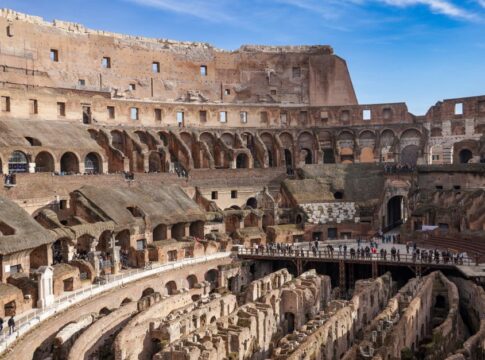
The Romans built their empire on concrete—literally. From the Colosseum to the aqueducts that stretched across Europe, they constructed monuments that have withstood earthquakes, wars, and two millennia of weathering. The key ingredient was pozzolana, a volcanic ash abundant near Mount Vesuvius and other volcanic regions throughout Italy. When mixed with lime and seawater, this ash created a chemical cocktail unlike anything used in modern construction.
Modern concrete relies on Portland cement, developed in the 19th century. It’s incredibly strong when fresh and sets quickly, making it ideal for contemporary construction timelines. But it has a fatal flaw: it’s essentially inert once it hardens. When cracks form—and they always do—the damage is permanent and progressive. Water seeps in, freezing and expanding in winter, corroding steel reinforcement bars, and gradually destroying the structure from within.
Roman concrete works differently. The volcanic ash contains silica and alumina that react with lime in the presence of seawater. This reaction doesn’t stop when the concrete sets. Instead, it continues for centuries, creating new crystalline structures that fill microscopic cracks and actually strengthen the material over time. Researchers studying ancient Roman harbor structures discovered rare mineral formations called aluminum-tobermorite crystals growing within the concrete—minerals that only form through prolonged exposure to seawater and that bind the material together more tightly than the original mixture.
The Chemistry of Self-Healing Ancient Structures
When seawater permeates Roman concrete—which would spell doom for modern structures—it initiates a beneficial chemical process. The alkaline lime mortar reacts with the volcanic ash and seawater to produce tobermorite and phillipsite crystals. These minerals interlock like microscopic rebar, creating a dense, cohesive structure that resists fracturing.
The process resembles how bones heal themselves. Small cracks don’t propagate; instead, they become sites for new crystal growth. The concrete literally gets stronger in the places where it experiences stress. Ancient Roman breakwaters and piers submerged in the Mediterranean for two thousand years show this process in action, with crystal structures visible under microscopic analysis that weren’t present when the concrete was first poured.
Temperature plays a role too. The Romans mixed their concrete hot, using quicklime that generated significant heat when combined with water. This high-temperature mixing allowed the volcanic ash to dissolve more completely and react more thoroughly with the other ingredients. Modern concrete, mixed at ambient temperatures, never achieves the same degree of chemical integration.
What the Romans Knew (and Didn’t Know)
The fascinating truth is that the Romans probably didn’t understand why their concrete worked so well. They had no concept of crystalline structures or chemical reactions at the molecular level. They simply knew that mixing pozzolana with lime and seawater created an exceptionally durable building material, especially for structures exposed to seawater.
Ancient Roman engineer and architect Vitruvius wrote about concrete construction in the first century BCE, describing the properties of different volcanic ashes and recommending specific mixtures for different applications. His writings show careful empirical observation—noting that certain volcanic deposits produced better results than others—but no understanding of the underlying chemistry. The Romans refined their formula through centuries of trial and error, passing down successful recipes without knowing precisely why they succeeded.
This empirical approach led to regional variations. Roman concrete in different parts of the empire used local volcanic materials, each with slightly different mineral compositions. Some have proven more durable than others, giving modern researchers multiple formulas to study and compare.
Modern Concrete vs. Roman Concrete: A Comparison
| Feature | Roman Concrete | Modern Portland Cement Concrete |
|---|---|---|
| Primary Binder | Lime and volcanic ash (pozzolana) | Portland cement (limestone and clay) |
| Typical Lifespan | 2,000+ years (still standing) | 50-100 years before major repairs needed |
| Reaction to Seawater | Strengthens through crystal growth | Deteriorates due to salt corrosion |
| Initial Strength | Lower, takes longer to cure | Higher, sets quickly |
| Self-Healing Properties | Yes, ongoing crystallization | No, damage is permanent |
| Carbon Footprint | Lower (lime production less energy-intensive) | Higher (cement production extremely energy-intensive) |
Can We Recreate Roman Concrete Today?
Scientists and engineers are actively working to reproduce Roman concrete formulas for modern use. The environmental benefits alone make this pursuit worthwhile. Cement production is one of the largest industrial sources of carbon dioxide emissions globally, contributing roughly eight percent of all human-generated CO2. Roman concrete requires less energy to produce and lasts far longer, potentially reducing both manufacturing emissions and the need for replacement.
The challenge isn’t recreating the formula—researchers have successfully done that in laboratories. The difficulty lies in scaling production and convincing the construction industry to adopt methods that require longer curing times and different construction techniques than current practice. Modern building schedules demand concrete that sets quickly. Roman concrete takes time to develop its full strength, making it impractical for many contemporary applications.
Some researchers are exploring hybrid approaches, incorporating volcanic ash or similar pozzolanic materials into Portland cement to capture some benefits of the Roman formula while maintaining the quick-setting properties modern construction requires. Early results show promise, particularly for marine structures where seawater exposure would activate the beneficial crystallization process.
Frequently Asked Questions
How long does Roman concrete last compared to modern concrete?
Roman concrete structures have survived over 2,000 years and continue to strengthen, while modern concrete typically requires major repairs or replacement after 50 to 100 years, particularly in harsh environments or when exposed to seawater.
What makes Roman concrete stronger over time?
Roman concrete contains volcanic ash that reacts with lime and seawater to create rare crystalline minerals like aluminum-tobermorite and phillipsite. These crystals grow within the concrete over centuries, filling microscopic cracks and binding the material more tightly together.
Why don’t we use Roman concrete today?
Roman concrete takes much longer to cure and reach full strength than modern Portland cement, making it impractical for contemporary construction timelines. The construction industry is also built around existing Portland cement infrastructure and practices that would be costly to change.
Did the Romans invent concrete?
The Romans didn’t invent concrete, but they perfected it and used it more extensively than any previous civilization. Earlier cultures used primitive concrete-like materials, but the Romans developed the durable volcanic ash formula and built monumental structures that showcased its potential.
The next time you see a crumbling concrete overpass or deteriorating parking garage, consider that structures built by an ancient civilization without modern chemistry or engineering still stand strong across the Mediterranean. Sometimes the old ways really were better—we just needed two thousand years and electron microscopes to figure out why.