
By TrivBits, Staff Writer — Published October 12, 2026
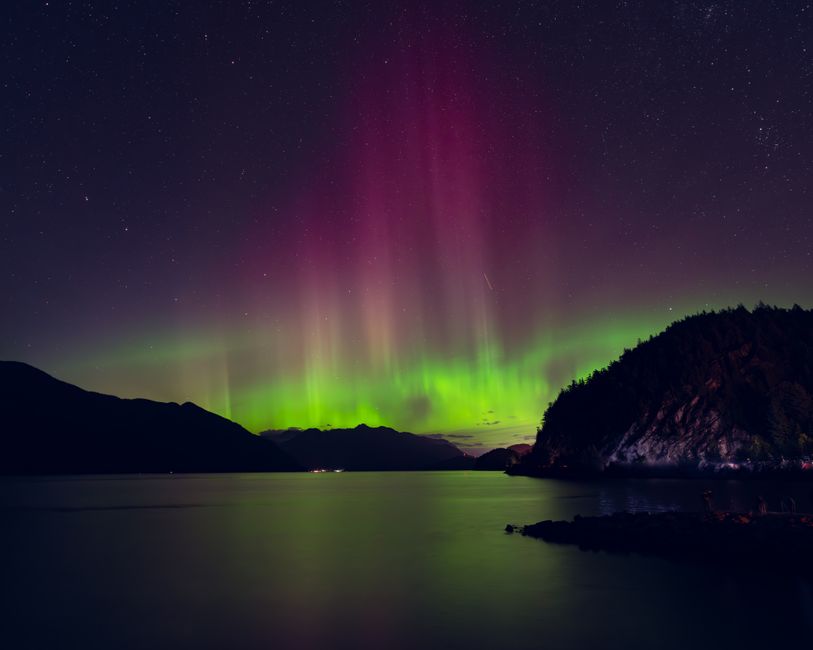
Table of Contents
- Key Takeaways
- What Causes Northern Lights: The Collision Story
- The Green Truth: Oxygen’s Dominant Display
- Red Auroras: The High-Altitude Mystery
- Blue and Purple: Nitrogen’s Contribution
- The Color Altitude Table
- Myths and Misconceptions About Aurora Colors
- Frequently Asked Questions
- Sources
The shimmering curtains of light that dance across polar skies have captivated humanity for millennia. But what causes northern lights to glow in different colors? The answer lies not in magic or mythology, but in atmospheric chemistry. Did you know that the specific gases colliding with charged solar particles determine whether you’ll see green, red, purple, or blue? This surprising truth reveals how our planet’s invisible shield transforms solar violence into celestial art.
Each color tells a story about altitude, atmospheric composition, and the energy of particle collisions happening roughly 60 to 200 miles above Earth’s surface. The facts behind these color variations are more fascinating than most myths suggest.
Key Takeaways
- Oxygen produces green auroras at lower altitudes (60-150 miles) and rare red displays at higher altitudes (above 150 miles)
- Nitrogen creates blue and purple hues, with blue appearing more prominently at lower altitudes
- The energy level of particle collisions determines color intensity and which wavelengths of light are emitted
- Green is the most common aurora color because oxygen is abundant at typical aurora altitudes
- Multiple colors can appear simultaneously at different heights, creating layered curtains of light
- Solar wind strength affects not just aurora intensity but also which colors become visible
What Causes Northern Lights: The Collision Story
The northern lights begin their journey 93 million miles away when the sun ejects charged particles into space. These particles—mostly electrons and protons—travel through the solar system as solar wind. When Earth’s magnetic field catches these particles, it funnels them toward the polar regions. Here’s where the interesting trivia begins.
As solar particles slam into Earth’s atmosphere, they collide with gas molecules. These collisions transfer energy to atmospheric gases, exciting their electrons to higher energy states. When electrons return to their normal state, they release that energy as light. The specific color depends entirely on which gas gets hit and at what altitude.
Think of it like a cosmic neon sign. Different gases emit different colors when energized, and the atmosphere’s composition changes dramatically with altitude. This creates nature’s most spectacular light show.
The Green Truth: Oxygen’s Dominant Display
Green auroras dominate the night sky for a simple reason: oxygen abundance. At altitudes between 60 and 150 miles, oxygen molecules are plentiful and perfectly positioned to intercept incoming solar particles. When energized oxygen atoms release photons, they emit a characteristic yellow-green light at a wavelength of 557.7 nanometers.
This particular shade of green happens to fall right where human eyes are most sensitive. Evolution optimized our vision for daylight, which peaks in the green spectrum. So not only is green light the most commonly produced aurora color, it’s also the one we’re best equipped to see. Double advantage.
The reaction happens relatively quickly. Oxygen atoms at these altitudes can emit their green glow within a fraction of a second after collision. This rapid response creates the dynamic, flowing curtains that make auroras so mesmerizing to watch.
Red Auroras: The High-Altitude Mystery
Red auroras are rare and haunt the highest reaches of aurora displays. Above 150 miles, oxygen still exists but in much lower concentrations. At these extreme altitudes, oxygen atoms have more time between collisions with other particles. This allows a different, slower energy transition to occur.
Instead of emitting green light, high-altitude oxygen produces red light at 630 nanometers. This transition takes up to two minutes—an eternity in atomic terms. At lower altitudes, excited oxygen atoms would collide with other molecules before completing this slow transition, preventing red light emission entirely.
During particularly intense geomagnetic storms, red auroras can extend lower into the atmosphere, creating spectacular all-red displays visible from mid-latitude locations. These events often make headlines because they’re so unusual and visually stunning.
Blue and Purple: Nitrogen’s Contribution
Nitrogen adds the cool tones to aurora displays. When solar particles strike nitrogen molecules, they can produce blue or purple light depending on the type of collision. Ionized nitrogen—nitrogen that has lost an electron—emits blue light. Neutral nitrogen excited by collisions produces purple or magenta hues.
Blue auroras typically appear at the lower edges of displays, below 60 miles altitude. Here, nitrogen is more concentrated and collisions are more frequent. The blue is often subtle, appearing as a fringe beneath brighter green curtains.
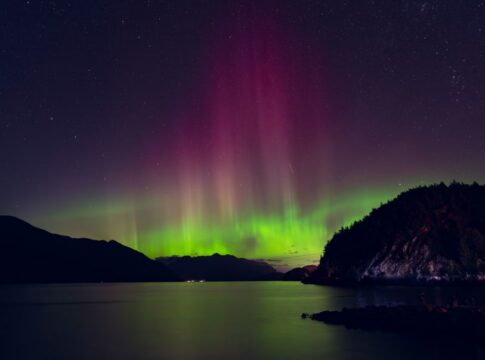
Purple represents a mixture. When blue nitrogen emissions combine with red oxygen from higher altitudes, the resulting color blends into purple or violet. Some observers report deep magenta edges during particularly active displays—a sign that multiple atmospheric layers are being energized simultaneously.
The Color Altitude Table
| Color | Primary Gas | Typical Altitude Range | Relative Frequency |
|---|---|---|---|
| Green | Oxygen | 60-150 miles | Most common |
| Red | Oxygen | Above 150 miles | Rare |
| Blue | Nitrogen (ionized) | Below 60 miles | Uncommon |
| Purple/Magenta | Nitrogen (neutral) | 60-100 miles | Occasional |
Myths and Misconceptions About Aurora Colors
One persistent myth suggests that auroras only appear green in photographs, not to the naked eye. This isn’t entirely accurate. While cameras can capture colors invisible to dark-adapted eyes, vivid green auroras are absolutely visible without technological aid. During strong displays, colors become saturated enough for anyone to see.
Another misconception claims that all auroras look the same worldwide. The southern lights (aurora australis) follow identical physical principles but can appear different due to varying atmospheric conditions and observation angles. The chemistry remains constant; the viewing experience varies.
Some believe pollution affects aurora colors. While light pollution certainly reduces visibility, atmospheric composition at aurora altitudes remains largely unaffected by ground-level emissions. The gases causing color variations exist far above where human activity has any meaningful impact.
Frequently Asked Questions
Can you see all aurora colors at once?
Yes, during intense geomagnetic storms, multiple colors can appear simultaneously in layered bands. Green typically dominates the lower curtains, red may crown the top, and blue or purple can fringe the bottom edges. The display reflects the vertical structure of atmospheric gases being excited at different altitudes.
Why are some auroras white or colorless?
Faint auroras often appear white or pale to human eyes because our color vision diminishes in low light. The aurora is still producing colored light, but our rod cells (which detect dim light) cannot distinguish colors. Cameras with long exposures reveal the true colors our eyes cannot perceive.
Do aurora colors change during a display?
Absolutely. As solar wind intensity fluctuates, the energy of particle collisions changes, shifting which atmospheric layers get excited. A display might start predominantly green, then develop red tops during peak activity, before fading back to green. These transitions can happen within minutes.
Are there aurora colors we can’t see?
Yes. Auroras emit ultraviolet and infrared light invisible to human eyes. Special instruments detect these wavelengths, revealing additional complexity in aurora emissions. The full electromagnetic spectrum of an aurora is far richer than what we can see visually.
Next time you witness the northern lights, you’re not just seeing a beautiful display—you’re watching real-time atmospheric chemistry in action. Each color represents a specific gas responding to solar particles in its own unique way, painting the sky with the fundamental physics of our planet’s invisible shield. The truth behind the colors makes the magic even more remarkable.