
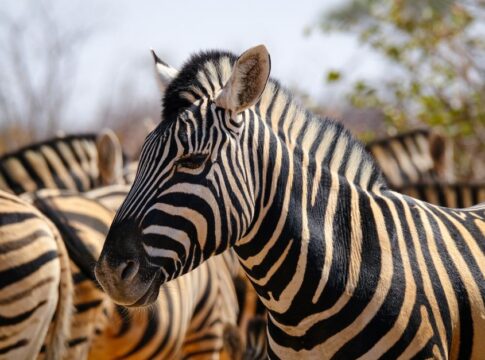
Why Zebras Have Stripes: The Surprising Science Revealed
By Trivia Daily, Staff Writer — Published July 30, 2026
Table of Contents
- Key Takeaways
- The Zebras Stripes Science: Debunking the Camouflage Myth
- How Stripes Repel Biting Insects
- Temperature Regulation and Other Benefits
- Comparing Zebra Species and Their Stripes
- Evolution’s Surprising Solution
- Frequently Asked Questions
For centuries, the zebra’s bold black-and-white stripes have puzzled scientists and nature lovers alike. You might assume these distinctive patterns serve as camouflage, but the real zebras stripes science tells a far more surprising story. Recent research has uncovered fascinating truths about why these African equines evolved their iconic coats—and the answer involves bloodsucking insects more than predator evasion.
The question of zebra stripes has sparked scientific curiosity for generations, with theories ranging from temperature regulation to social signaling. Modern studies using controlled experiments have finally begun to reveal the primary purpose behind nature’s most recognizable pattern.
Key Takeaways
- The primary function of zebra stripes is to deter biting flies, particularly horseflies and tsetse flies, which struggle to land on striped surfaces.
- Contrary to popular belief, zebra stripes do not provide effective camouflage against predators like lions, whose vision differs significantly from human perception.
- All three zebra species—plains, mountain, and Grevy’s zebras—display unique stripe patterns, with no two zebras sharing identical markings.
- Temperature regulation through stripes remains a secondary benefit, as air currents may form differently over alternating black and white fur.
- The stripe pattern extends to a zebra’s skin beneath the fur, making it a fundamental characteristic rather than just a surface feature.
- Zebra stripes likely evolved in regions with high concentrations of disease-carrying flies, where bite prevention offered significant survival advantages.
The Zebras Stripes Science: Debunking the Camouflage Myth
Most people grow up learning that zebra stripes help them blend into tall grass or confuse predators. This interesting theory sounds logical but doesn’t hold up under scientific scrutiny. Lions and other major predators hunt primarily at dawn and dusk when light is dim, and their vision is adapted for detecting movement rather than fine patterns.
Research examining predator vision has shown that at the distances where lions typically spot prey, zebras appear relatively uniform in color to feline eyes. The high-contrast stripes that seem so obvious to humans don’t translate the same way through a lion’s visual system. Even the “motion dazzle” hypothesis—suggesting that stripes confuse predators when zebras run—lacks strong experimental support.
What truly sets zebras apart from their stripe-free relatives like horses and donkeys is their habitat. Zebras inhabit regions of Africa where biting flies carry devastating diseases, including trypanosomiasis and African horse sickness. These flies pose a constant threat to large mammals, making effective deterrents a matter of life and death.
How Stripes Repel Biting Insects
Scientists have conducted fascinating experiments to test whether stripes actually deter flies. In one study, researchers dressed horses in zebra-patterned coats and compared fly landing rates to horses in solid-colored coverings. The results were striking: flies approached both groups equally but struggled to land successfully on the striped patterns.
High-speed video footage revealed the mechanism behind this phenomenon. Biting flies need to slow down and make a controlled landing to successfully bite their target. When approaching striped surfaces, flies appeared to misjudge their landing, often overshooting or pulling up at the last second. The optical effect created by alternating stripes seems to interfere with the flies’ ability to decelerate properly.
This discovery represents a remarkable example of evolution solving a specific environmental challenge. In regions where disease-carrying flies are less common, related equine species like horses evolved without stripes. The pattern appears precisely where it provides the greatest survival advantage.
The Physics Behind the Pattern
The stripe width on zebras isn’t random. Most stripes measure between four and six inches wide, which may represent an optimal size for disrupting fly vision. Narrower stripes might not create sufficient optical confusion, while wider stripes could lose the disruptive effect entirely.
Different body regions show varying stripe patterns. Leg stripes tend to be narrower and more horizontal, while body stripes run more vertically. This variation might reflect different functional needs or simply represent how the pattern develops during embryonic growth.
Temperature Regulation and Other Benefits
While fly deterrence appears to be the primary function, zebra stripes may offer additional benefits. The temperature regulation hypothesis suggests that black stripes absorb more heat than white stripes, potentially creating small air currents over the zebra’s body that help with cooling.
Some evidence supports this idea. Studies measuring surface temperatures on zebra hides have found temperature differences of several degrees between black and white stripes. Whether these differences create meaningful cooling effects remains debated, but the physics is sound—differential heating can generate air movement.
Social recognition represents another possible function. Zebras are highly social animals that live in family groups, and individuals may recognize each other by their unique stripe patterns. Foals must quickly learn to identify their mothers in busy herds, and distinctive markings could facilitate this crucial bonding.
Comparing Zebra Species and Their Stripes
| Species | Stripe Pattern | Habitat | Notable Features |
|---|---|---|---|
| Plains Zebra | Wide stripes extending to belly; some have shadow stripes | Grasslands and savannas | Most common species; stripes vary by subspecies |
| Grevy’s Zebra | Narrow, closely-spaced stripes; white belly | Semi-arid grasslands | Largest zebra species; endangered status |
| Mountain Zebra | Vertical stripes with distinctive grid pattern on rump | Mountainous regions of southern Africa | Smallest species; dewlap under throat |
Evolution’s Surprising Solution
The evolution of zebra stripes demonstrates how natural selection responds to specific environmental pressures. Genetic studies suggest that striping patterns are controlled by multiple genes working together, allowing for the variation we see between species and individuals.
Interestingly, other animals have evolved similar solutions to the same problem. Some antelope species in fly-dense regions display striping or bold patterns, though none as dramatic as zebras. This convergent evolution strengthens the case that stripes serve a functional purpose rather than being purely decorative.
The fact that zebra stripes appear even on the skin beneath the fur reveals how deeply embedded this trait is. It’s not merely a pigmentation pattern in the hair but a fundamental aspect of zebra biology that develops early in embryonic growth.
Frequently Asked Questions
Are zebras white with black stripes or black with white stripes?
Zebras are fundamentally black with white stripes. Embryological evidence shows that zebra embryos start as dark-colored and develop white stripes as pigment is selectively inhibited in certain areas. The black coloration represents the base coat.
Can zebra stripes prevent all insect bites?
No, stripes primarily deter larger biting flies like horseflies and tsetse flies but don’t protect against all insects. Smaller flies and other parasites can still land and bite successfully, though zebras experience fewer bites overall compared to similarly-sized solid-colored animals in the same habitats.
Do baby zebras have the same stripe pattern as adults?
Yes, zebra foals are born with their complete stripe pattern, though the stripes may appear brownish rather than pure black initially. The pattern remains consistent throughout life, allowing researchers to identify individual zebras by their unique markings much like human fingerprints.
Why don’t horses have stripes if they deter flies?
Horses evolved in regions with fewer disease-carrying flies, so the evolutionary pressure to develop stripes was absent. Domestic horses descended from wild populations in Eurasia where biting fly populations were lower than in the African habitats where zebras evolved.
The zebra’s stripes stand as a testament to evolution’s creativity in solving biological challenges. What appears to be simple decoration actually represents millions of years of adaptation to a specific threat—one so small it buzzes rather than roars. Next time you see a zebra, remember you’re looking at nature’s surprisingly effective insect repellent.