
Why Honey Never Spoils: Ancient Jars Still Edible Today
By TrivBits, Staff Writer — Published July 29, 2026
Table of Contents
- Key Takeaways
- Why Honey Never Spoils: The Science Behind Eternal Preservation
- The Chemistry That Creates an Inhospitable Environment
- From Flower to Forever: How Bees Engineer Immortal Food
- Common Honey Myths and Misconceptions
- Comparing Honey to Other Long-Lasting Foods
- Frequently Asked Questions
Archaeologists excavating ancient Egyptian tombs have made a sweet discovery that continues to amaze scientists: jars of honey thousands of years old, still perfectly edible. This isn’t folklore or exaggeration—honey never spoils, making it one of nature’s most remarkable preservatives. While other foods decay within days or weeks, honey remains unchanged for millennia, defying the normal rules of decomposition. What makes this golden substance so different from virtually every other food on Earth?
The answer lies in a fascinating combination of chemistry, biology, and the incredible engineering of honeybees. Understanding why honey never spoils reveals surprising facts about how we preserve food, what bacteria need to survive, and the intricate processes that turn flower nectar into an eternal food source.
Key Takeaways
- Honey found in ancient Egyptian tombs dating back over 3,000 years remains perfectly preserved and technically edible due to its unique chemical properties.
- The extremely low moisture content of honey (typically 17-18%) creates an environment where bacteria and microorganisms cannot survive or reproduce.
- Honey’s natural acidity, with a pH between 3 and 4.5, inhibits the growth of most pathogens and spoilage organisms.
- When bees process nectar, they add an enzyme that produces hydrogen peroxide, giving honey natural antibacterial properties.
- Crystallization is a natural process that doesn’t indicate spoilage—crystallized honey can be gently warmed to return to its liquid state.
- Pure, properly stored honey is the only food that truly never expires, though commercial honey often carries “best by” dates for quality purposes.
Why Honey Never Spoils: The Science Behind Eternal Preservation
Honey’s immortality stems from a perfect storm of inhospitable conditions for microorganisms. Bacteria, mold, and other spoilage agents need water to survive. They rely on moisture to dissolve nutrients and carry out the metabolic processes that keep them alive. Honey contains so little available water that microbes simply cannot function.
The water content in honey typically hovers around 17-18%. Compare this to most fruits and vegetables, which contain 80-95% water. This dramatic difference matters because honey is also supersaturated with sugars—meaning it contains more dissolved sugar than water would normally hold at room temperature. When a bacterium lands in honey, osmosis draws water out of the cell, effectively mummifying the microorganism before it can multiply.
Scientists call this principle “water activity,” and honey scores remarkably low. Water activity measures the amount of water available for biological processes on a scale from 0 to 1. Most bacteria need a water activity above 0.91 to grow. Honey clocks in at about 0.6, well below the threshold where life can flourish.
The Chemistry That Creates an Inhospitable Environment
Beyond its dryness, honey wields chemical weapons against spoilage. Its pH ranges from 3 to 4.5, making it acidic enough to inhibit most pathogens. This acidity comes from gluconic acid, which forms when bees add an enzyme called glucose oxidase to nectar during honey production.
That same enzyme creates another defensive compound: hydrogen peroxide. When honey comes into contact with moisture—say, when diluted or applied to a wound—glucose oxidase becomes active and produces hydrogen peroxide, a well-known antiseptic. Ancient civilizations didn’t understand the chemistry, but they recognized honey’s medicinal properties and used it to treat wounds and infections.
The high sugar concentration itself acts as a preservative through a process called hygroscopy. Sugar molecules bind to water molecules, making them unavailable for microorganisms. This is why humans have used sugar to preserve jams, jellies, and candied fruits for centuries—though none achieve honey’s perfect preservation.
From Flower to Forever: How Bees Engineer Immortal Food
Honeybees don’t just collect honey—they manufacture it through an intricate process that transforms watery nectar into an eternal food source. Forager bees gather nectar containing 60-80% water. Back at the hive, worker bees pass the nectar from bee to bee, each one adding enzymes and evaporating moisture by fanning their wings.
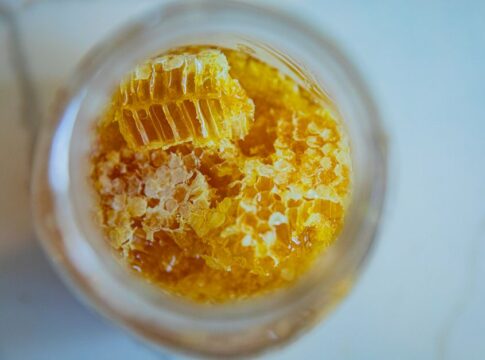
The bees deposit the thickening nectar into hexagonal wax cells and continue the evaporation process until the water content drops below 20%. Once satisfied, they cap the cells with wax, sealing the honey in an airtight chamber. This process typically takes several days of constant work by hundreds of bees.
The bees’ motivation isn’t preservation for preservation’s sake—they’re creating a concentrated energy source to sustain the colony through winter when flowers aren’t blooming. The fact that their food supply lasts indefinitely is a remarkable evolutionary bonus that humans have exploited for at least 8,000 years.
Common Honey Myths and Misconceptions
Many people panic when their honey crystallizes, assuming it has spoiled. Crystallization is actually a natural process that confirms your honey is pure. The glucose in honey naturally separates from the water and forms crystals. Different floral sources crystallize at different rates—clover honey crystallizes quickly, while acacia honey may stay liquid for years.
You can reverse crystallization by gently warming the honey in a water bath. Avoid microwaving or overheating, as temperatures above 140°F can destroy some of honey’s beneficial enzymes and alter its flavor. Crystallized honey is completely safe to eat and some people prefer its spreadable texture.
Another myth suggests raw honey is unsafe because it hasn’t been pasteurized. While raw honey may contain trace amounts of pollen and propolis, its antibacterial properties prevent harmful bacteria from growing. The exception is for infants under one year old—honey can contain dormant botulism spores that are harmless to older children and adults but dangerous to babies whose digestive systems haven’t fully developed.
Comparing Honey to Other Long-Lasting Foods
| Food Item | Typical Shelf Life | Preservation Method | Can Truly Last Forever? |
|---|---|---|---|
| Honey | Indefinite | Low moisture, acidity, enzymes | Yes |
| White rice (uncooked) | 30+ years | Low moisture, airtight storage | No—eventually oxidizes |
| Salt | Indefinite | Mineral—not organic | Yes (but not food) |
| Dried beans | 10+ years | Dehydration | No—lose nutrition, become hard |
| Maple syrup | Indefinite (unopened) | High sugar concentration | No—can develop mold when opened |
Frequently Asked Questions
Can honey actually go bad under any circumstances?
Honey can ferment if its moisture content rises above 19-20%, which can happen if stored in humid conditions or if the honey was harvested before bees fully cured it. Fermented honey develops an off smell, fizzy texture, and alcoholic taste. Proper storage in airtight containers prevents this.
Why do honey jars have expiration dates if honey never spoils?
Expiration dates on honey are required by food labeling regulations and indicate peak quality rather than safety. Over time, honey may darken in color or change flavor slightly, but it remains safe to eat indefinitely when stored properly.
Is the honey found in Egyptian tombs really still edible?
Yes, archaeologists have discovered honey in ancient Egyptian tombs that remains preserved after more than 3,000 years. While no one has conducted formal taste tests for safety reasons, the honey shows no signs of spoilage and theoretically remains edible due to its chemical properties.
Does heating honey destroy its ability to last forever?
Heating honey above 140°F can destroy some beneficial enzymes and alter flavor compounds, but it doesn’t eliminate honey’s fundamental preservation properties—its low moisture content and high sugar concentration remain unchanged. Heated honey will still last indefinitely.
The next time you drizzle honey into your tea or spread it on toast, you’re using a food that connects us directly to ancient civilizations. That same jar could theoretically sit on your shelf for thousands of years, outlasting not just you but countless generations to come—a sweet reminder that nature sometimes engineers solutions more perfect than anything humans could design.