
⏱️ 6 min read
The Egyptian pyramids stand as some of humanity’s most iconic architectural achievements, dominating the desert landscape for over 4,500 years. While most people recognize these ancient structures as monumental tombs for pharaohs, the pyramids harbor numerous secrets and surprising facts that challenge common assumptions and reveal the incredible ingenuity of ancient Egyptian civilization.
Remarkable Discoveries That Challenge What We Know
1. Workers Were Not Slaves But Paid Laborers
Contrary to popular belief perpetuated by Hollywood films and historical misconceptions, the pyramids were not built by slaves. Archaeological evidence discovered near the Giza plateau reveals that the workers were actually paid laborers who received compensation for their efforts. Excavations have uncovered workers’ villages complete with bakeries, breweries, and medical facilities. These laborers were fed well, receiving daily rations of bread and beer, and were given proper medical care when injured. Graffiti left by work gangs suggests a sense of pride in their contributions, with crews giving themselves names like “Friends of Khufu” and competing for recognition.
2. The Great Pyramid Was the World’s Tallest Structure for Nearly 4,000 Years
The Great Pyramid of Khufu held the record as the tallest man-made structure on Earth for approximately 3,800 years, standing at an original height of 146.5 meters (481 feet). This record remained unbroken until the construction of Lincoln Cathedral in England around 1311 CE. The sheer longevity of this achievement demonstrates the unprecedented engineering capabilities of ancient Egyptian architects and the remarkable durability of their construction methods.
3. The Pyramids Were Originally Covered in White Limestone Casing
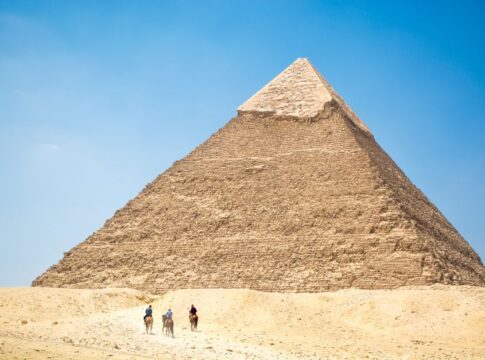
The pyramids we see today as brown, stepped structures looked dramatically different in ancient times. They were originally covered with highly polished white Tura limestone casing stones that reflected the sun’s light, making them shine brilliantly and visible from miles away. The ancient Egyptians called the Great Pyramid “Ikhet,” meaning “Glorious Light.” These smooth casing stones were removed over centuries, primarily during the Middle Ages, and used to build mosques and fortresses in Cairo. Only a few casing stones remain at the top of Khafre’s pyramid, giving us a glimpse of their original magnificent appearance.
4. The Pyramids Are Precisely Aligned with Cardinal Directions
The Great Pyramid demonstrates astonishing astronomical precision, with its sides aligned almost perfectly with the four cardinal directions—north, south, east, and west. The margin of error is remarkably small, with the north-south axis accurate to within 3/60th of a single degree. This level of precision was achieved without modern instruments like compasses or GPS technology. Archaeologists believe the ancient Egyptians used stellar observations, possibly tracking circumpolar stars or using the sun’s shadow at specific times, to achieve this extraordinary alignment.
5. Eight Sides Instead of Four
While they appear to have four sides, the Great Pyramid actually has eight sides. Each of the four faces is slightly indented along its centerline, creating a subtle concave effect that is nearly imperceptible from the ground and only visible from the air under specific lighting conditions, particularly during the spring and autumn equinoxes. This architectural feature may have been intentional, possibly to prevent casing stones from loosening or for astronomical purposes, though its exact purpose remains debated among Egyptologists.
6. Construction Speed Was Extraordinarily Rapid
The Great Pyramid contains approximately 2.3 million limestone blocks, each weighing between 2.5 and 15 tons. If the commonly accepted 20-year construction timeline is accurate, this means workers had to quarry, transport, and precisely place roughly 800 tons of stone every single day, or about one block every two to three minutes during a 10-hour workday. This incredible pace required exceptional organization, logistics, and workforce coordination that rivals modern construction projects, despite the absence of mechanical equipment.
7. Internal Temperature Remains Constant
Regardless of external desert temperatures that can fluctuate dramatically between scorching days and cold nights, the interior chambers of the pyramids maintain a constant temperature of approximately 20 degrees Celsius (68 degrees Fahrenheit). This temperature happens to be the average temperature of the Earth. This remarkable climate control occurs naturally due to the massive thermal mass of the limestone structure and its design, which creates an effective passive cooling system that would be the envy of modern architects.
8. Mortar Stronger Than the Stone Itself
The mortar used to bind the pyramid blocks has been analyzed by modern scientists and found to be incredibly durable—in some cases, stronger than the limestone blocks themselves. Despite decades of research, the exact chemical composition of this ancient mortar remains something of a mystery. Scientists have identified it as a form of gypsum mortar, but attempts to recreate its exact properties have been unsuccessful. This speaks to the sophisticated understanding of materials science possessed by ancient Egyptian engineers.
9. Swivel Doors Weighing Multiple Tons
The original entrance to the Great Pyramid featured sophisticated swivel doors made of massive stone blocks weighing approximately 20 tons each. Despite their enormous weight, these doors were so perfectly balanced on metal pins that they could be opened from the inside with minimal effort—reportedly by pushing with one hand. However, they were nearly impossible to detect from the outside when closed, as they fit so seamlessly into the pyramid’s surface. This engineering feat demonstrates remarkable understanding of physics and precision manufacturing.
10. The Pyramids Were Not Built in Isolation
While the pyramids dominate our imagination, they were actually part of vast funerary complexes that included temples, smaller satellite pyramids, causeways, and entire cities for workers and priests. The Giza plateau contained workers’ villages, administrative buildings, workshops, and storage facilities. These complexes required sophisticated urban planning and sustained economic output from the entire kingdom. The pyramids represented only the most visible component of an elaborate religious and administrative infrastructure that supported the pharaoh’s journey to the afterlife.
Enduring Mysteries and Legacy
These surprising facts about the Egyptian pyramids reveal structures far more complex and sophisticated than simple tombs in the desert. From their advanced engineering techniques and astronomical alignments to their organizational achievements and material science innovations, the pyramids represent the pinnacle of ancient Egyptian civilization’s capabilities. They continue to challenge modern understanding and inspire new research, ensuring that these monuments will remain subjects of fascination and study for generations to come. The pyramids stand not merely as tombs for ancient kings, but as testaments to human ingenuity, determination, and the desire to create something truly eternal.