
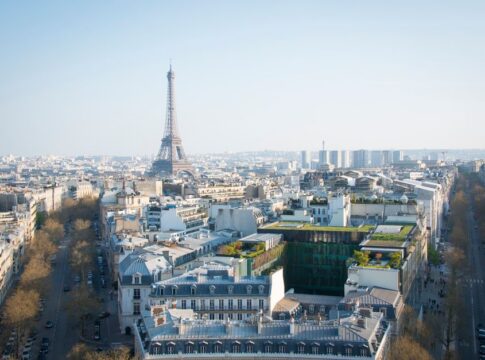
Why the Eiffel Tower Grows Taller in Summer Heat
By Trivia Daily, History Desk — Published August 4, 2026
Table of Contents
- Key Takeaways
- How the Eiffel Tower Grows in Summer
- Engineering for Movement in the 19th Century
- Thermal Expansion Across History
- Comparing Thermal Expansion in Famous Structures
- Modern Monitoring and Maintenance
- Frequently Asked Questions
The iron lady of Paris isn’t quite as rigid as she appears. On a scorching summer day, the Eiffel Tower grows taller—sometimes by as much as six inches. This isn’t an optical illusion or a quirk of measurement. It’s pure physics at work, a phenomenon that’s been documented since the tower’s completion in the late 19th century. The same scientific principle that causes railroad tracks to buckle and bridges to require expansion joints makes this iconic monument stretch skyward when temperatures rise.
Gustave Eiffel’s masterpiece, completed in 1889 for the Paris Exposition, stands as a testament to both engineering ambition and the immutable laws of thermodynamics. Built during an era when iron construction was revolutionizing architecture across empires and civilizations, the tower demonstrates that even the most solid-seeming structures are subject to the invisible forces of heat and cold.
Key Takeaways
- The Eiffel Tower can grow up to six inches taller during hot summer days due to thermal expansion of its iron structure.
- The tower contains approximately 7,300 tons of iron, all of which expands when heated and contracts when cooled.
- Gustave Eiffel designed the structure with thermal expansion in mind, incorporating flexible joints and careful engineering to accommodate the movement.
- The top of the tower can lean away from the sun by up to seven inches as the metal on the sunny side expands more than the shaded side.
- Temperature differences between summer and winter can exceed 60 degrees Fahrenheit in Paris, causing significant structural changes throughout the year.
- This same principle of thermal expansion was understood by ancient civilizations and has influenced construction techniques throughout history.
How the Eiffel Tower Grows in Summer
Thermal expansion is the tendency of matter to change in volume in response to temperature changes. When iron heats up, its atoms vibrate more energetically and take up more space. The Eiffel Tower, constructed almost entirely of puddled iron (a form of wrought iron popular in the 19th century), contains roughly 7,300 tons of metal that all respond to temperature fluctuations.
The math is straightforward. Iron expands by about 12 parts per million for every degree Celsius of temperature increase. The tower stands 324 meters tall (including antennas), and on a hot summer day when the iron might be 15 degrees Celsius warmer than on a cool spring morning, the entire structure stretches upward. Six inches might not sound like much for a thousand-foot tower, but it’s a measurable, consistent phenomenon that engineers and physicists have documented for over a century.
What makes this particularly fascinating is that the expansion isn’t uniform. The side facing the sun heats up faster and more intensely than the shaded side. This uneven heating causes the tower to lean slightly away from the sun—sometimes by as much as seven inches at the top. As the day progresses and the sun moves across the sky, the tower actually sways, following the heat.
Engineering for Movement in the 19th Century
Gustave Eiffel wasn’t caught off guard by thermal expansion. Engineers in his era understood the principle well, having grappled with it in railroad construction throughout the century. Train tracks, if laid without gaps, would buckle dangerously in summer heat. Bridges required expansion joints to prevent catastrophic failure. The industrial revolution had taught engineers across European empires hard lessons about the behavior of metal under temperature stress.
Eiffel incorporated this knowledge into his design. The tower’s lattice structure, with its 18,038 individual iron pieces held together by 2.5 million rivets, allows for subtle movement. The connections aren’t rigidly welded but rather assembled in ways that permit microscopic shifting. This flexibility means the tower can breathe with the seasons, expanding in summer and contracting in winter without sustaining damage.
The design also accounted for wind loads and other forces, but temperature remained a primary concern. Historical records from the tower’s construction show that Eiffel’s team measured components at specific temperatures to ensure proper fit. They understood that a piece fitted on a cold March morning would behave differently on a July afternoon.
Thermal Expansion Across History
Ancient civilizations grasped thermal expansion long before the scientific revolution formalized the concept. Greek and Roman architects left gaps between stone blocks in their monumental structures, partly to accommodate thermal movement. The Parthenon in Athens, built in the 5th century BCE, shows evidence of sophisticated understanding of how materials respond to temperature changes.
By the time of the Renaissance, European builders routinely incorporated expansion considerations into bridge and cathedral construction. The iron age of the 18th and 19th centuries made the issue more acute. Iron expands roughly twice as much as stone for the same temperature change, demanding greater precision in engineering calculations.
The Eiffel Tower emerged during a pivotal era when empirical engineering knowledge was being codified into mathematical principles. Scientists like Jacques Charles and Joseph Louis Gay-Lussac had established the relationships between temperature and volume in gases, and similar principles were being applied to solids. The tower became both a practical demonstration and a monument to this scientific progress.
Comparing Thermal Expansion in Famous Structures
| Structure | Material | Approximate Seasonal Change | Expansion Consideration |
|---|---|---|---|
| Eiffel Tower | Iron | Up to 6 inches in height | Flexible joints, lattice design |
| Golden Gate Bridge | Steel | Up to 3 feet in length | Expansion joints at towers |
| Empire State Building | Steel frame | Several inches in height | Flexible connections |
| Concrete highways | Concrete | Varies by length | Expansion joints every 12-15 feet |
Modern Monitoring and Maintenance
Today’s engineers continuously monitor the Eiffel Tower’s behavior. Sensors track temperature, wind, and structural movement. This data helps maintenance crews anticipate when paint will need touching up (the tower is repainted every seven years), when components might need inspection, and how the structure ages over time.
The tower has survived two world wars, countless storms, and over a century of thermal cycling. Its endurance validates Eiffel’s engineering genius. Modern analysis using computer modeling confirms what 19th-century engineers calculated by hand: the structure can safely accommodate its seasonal growth and shrinkage indefinitely.
Interestingly, the tower’s thermal behavior has become a teaching tool. Physics students around the world study it as a real-world example of thermal expansion. The fact that such a massive, solid-looking structure visibly responds to temperature makes abstract scientific principles tangible and memorable.
Frequently Asked Questions
Does the Eiffel Tower grow every single day?
Yes, the tower expands and contracts daily as temperatures fluctuate between day and night, though the most dramatic changes occur seasonally between summer and winter. Even a few degrees of temperature difference causes measurable movement.
Can visitors notice the Eiffel Tower’s height change?
No, six inches of height change on a 1,000-foot structure is imperceptible to the human eye. However, sensitive surveying equipment easily detects the difference, and the lateral lean toward the sun can be measured with precision instruments.
Do other metal towers experience the same growth?
Absolutely. Any tall metal structure experiences thermal expansion, including radio towers, observation towers, and skyscrapers with steel frames. The Eiffel Tower is simply the most famous and well-documented example of this universal physical phenomenon.
Did thermal expansion ever cause problems during the tower’s construction?
Eiffel’s team had to account for temperature when fitting pieces together, sometimes working early in the morning when temperatures were more predictable. Historical accounts suggest they occasionally had to wait for cloud cover or use water to cool overheated metal components before final assembly.
The next time you see a photograph of the Eiffel Tower against a summer sky, remember that the iron lattice is quietly responding to the heat, stretching upward in a dance between solid metal and invisible energy. It’s a reminder that even monuments we consider permanent are constantly in motion, breathing with the seasons just like the living city around them.