
By TrivBits, Staff Writer — Published October 25, 2026
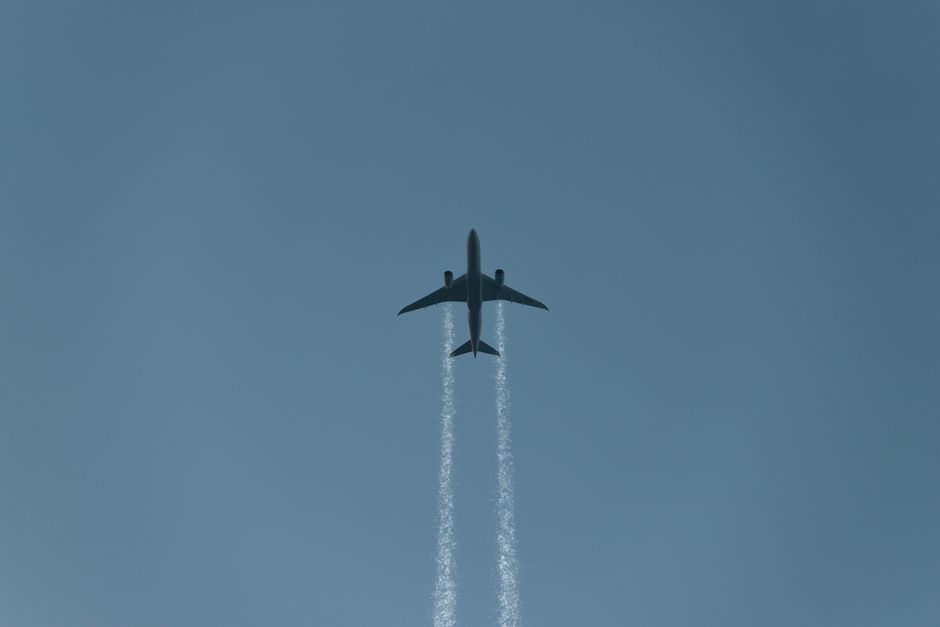
Table of Contents
- Key Takeaways
- What Causes Airplane Contrails: The Basic Chemistry
- Why Some Contrails Vanish While Others Persist
- The Surprising Truth About Contrail Composition
- Contrails as Unintentional Weather Indicators
- The Climate Connection: When Contrails Become Clouds
- Comparing Contrail Conditions
- Frequently Asked Questions
- Sources
Look up on a clear day and you might spot white streaks crisscrossing the sky behind high-flying jets. Some vanish almost instantly. Others spread into wispy clouds that last for hours. Did you know the difference isn’t random? What causes airplane contrails to persist or disappear reveals surprising truths about the invisible ocean of air surrounding our planet. These man-made clouds hold fascinating secrets about atmospheric conditions miles above Earth’s surface.
The science behind contrail behavior debunks common myths while uncovering interesting facts about humidity, temperature, and ice crystal formation. Understanding this phenomenon transforms those white lines from mundane sky decorations into windows revealing the upper atmosphere’s hidden characteristics.
Key Takeaways
- Contrails form when hot, humid jet exhaust meets extremely cold air, causing water vapor to instantly freeze into ice crystals
- Persistent contrails only occur when the surrounding air is supersaturated with moisture, allowing ice crystals to remain stable
- Temperature at cruising altitude must typically be below minus 40 degrees Celsius for contrails to form and linger
- Short-lived contrails indicate dry upper-atmosphere conditions, while long-lasting ones signal high humidity aloft
- Persistent contrails can evolve into cirrus-like clouds that affect Earth’s radiation balance
- Contrail persistence depends entirely on atmospheric conditions, not on aircraft type or fuel composition
What Causes Airplane Contrails: The Basic Chemistry
Jet engines burn fuel at scorching temperatures. The combustion process produces carbon dioxide, nitrogen compounds, and copious amounts of water vapor. When this hot, moisture-rich exhaust blasts into air that’s typically 50 to 60 degrees below zero Celsius, something remarkable happens almost instantly.
The water molecules don’t gradually cool. They flash-freeze.
This rapid phase change creates billions of tiny ice crystals in the aircraft’s wake. Think of it as instant cloud manufacturing. The exhaust also contains microscopic particles—soot and other combustion byproducts—that serve as nucleation sites where water molecules can gather and freeze. Without these tiny seeds, contrail formation would be far less efficient.
But here’s where it gets interesting: every airplane at high altitude produces this hot, humid exhaust. Yet not every airplane leaves a visible trail. The surrounding atmosphere determines whether those ice crystals survive or immediately evaporate back into invisible water vapor.
Why Some Contrails Vanish While Others Persist
The key factor is relative humidity with respect to ice. This technical term describes how saturated the air is compared to the maximum moisture it can hold at ice-freezing temperatures. Regular ground-level humidity measurements don’t apply at 30,000 feet where the rules change dramatically.
Air can be supersaturated with respect to ice, meaning it holds more moisture than it theoretically should. When ice crystals form in supersaturated air, they don’t evaporate. They grow. The crystals pull moisture from the surrounding atmosphere, getting larger and more visible over time. These are the contrails that spread and linger for hours.
When upper-atmosphere air is dry—below ice saturation—those initial ice crystals sublimate rapidly. They transform directly from solid to gas without passing through liquid form. The contrail disappears within seconds or minutes, leaving only empty sky. The aircraft flew through both scenarios, but the atmospheric moisture content dictated the outcome.
Temperature matters too. Contrails generally require temperatures below approximately minus 40 degrees Celsius. Above that threshold, ice crystals can’t remain stable regardless of humidity levels.
The Surprising Truth About Contrail Composition
A common myth suggests that persistent contrails contain mysterious chemicals or special additives. The truth is far more mundane and scientifically elegant. Persistent contrails are essentially cirrus clouds—high-altitude ice crystal formations indistinguishable from natural cloud types.
Laboratory analysis and atmospheric sampling confirm this. Contrails contain frozen water and trace amounts of atmospheric dust and combustion particles. That’s it. No secret ingredients. No unusual compounds. The longevity depends on whether Mother Nature’s upper atmosphere feels like hosting ice crystals that day.
Here’s an unknown fact that surprises many: the fuel type makes virtually no difference to contrail persistence. Jet fuel composition affects the number of nucleation particles produced, which can influence initial contrail formation, but atmospheric conditions alone determine whether the trail lingers or vanishes.
Contrails as Unintentional Weather Indicators
Pilots and meteorologists recognize persistent contrails as valuable atmospheric diagnostic tools. They reveal invisible moisture rivers flowing through the upper troposphere and lower stratosphere. Before satellite technology, these visual cues helped forecasters predict weather changes.
Widespread persistent contrails often precede warm fronts and approaching storm systems. Why? Because these weather patterns transport moisture-rich air into the upper atmosphere. The contrails simply make that hidden humidity visible. Conversely, clear skies with rapidly dissipating contrails suggest dry, stable atmospheric conditions likely to persist.
This natural indicator system has worked for decades. Experienced observers can read the sky’s contrail patterns like a meteorological newspaper printed in ice crystals.
The Climate Connection: When Contrails Become Clouds
Persistent contrails don’t simply hang in the sky unchanged. They evolve. Wind shear stretches them. Atmospheric turbulence distorts their linear shapes. Given enough time and the right conditions, they become indistinguishable from natural cirrus clouds, spreading into broader, thinner formations.
These human-induced cirrus clouds affect Earth’s energy balance in complex ways. During daylight, they reflect some incoming sunlight back to space, creating a cooling effect. At night, they trap outgoing infrared radiation, warming the surface below. The net effect varies by time, location, and cloud characteristics, making it a subject of ongoing atmospheric research.
Studies estimate that in regions with heavy air traffic, contrail-generated cloudiness can be substantial. Some researchers calculate that aviation’s climate impact from contrail cirrus may rival or exceed the warming effect from aircraft carbon dioxide emissions, though uncertainties remain large.
Comparing Contrail Conditions
| Atmospheric Condition | Temperature | Humidity (Ice Saturation) | Contrail Behavior |
|---|---|---|---|
| Rapid Dissipation | Below -40°C | Below 100% (dry) | Disappears in seconds to minutes |
| Moderate Persistence | Below -40°C | Near 100% (saturated) | Visible for several minutes, limited spreading |
| Long Persistence | Below -40°C | Above 100% (supersaturated) | Lasts hours, spreads into cirrus-like clouds |
| No Formation | Above -40°C | Any level | No visible contrail forms |
Frequently Asked Questions
Are persistent contrails harmful to breathe?
No. Persistent contrails form at altitudes of roughly 26,000 to 40,000 feet, far above the air we breathe at ground level. They consist primarily of ice crystals that sublimate or fall as tiny particles that disperse across vast atmospheric volumes before reaching the surface. Any combustion particles are diluted to negligible concentrations.
Why do contrails sometimes appear in grid patterns?
Modern air traffic follows structured routes and flight levels assigned by air traffic control. When atmospheric conditions favor persistent contrails, multiple aircraft flying perpendicular routes at different times create intersecting lines that resemble grids. The pattern reflects organized airspace management, not coordinated spraying activities.
Can contrails affect local weather?
Individual contrails have minimal direct impact on surface weather. However, in regions with dense air traffic and favorable atmospheric conditions, extensive contrail-cirrus coverage can slightly modify local temperature ranges by affecting radiative transfer. The effect is generally small compared to natural weather variability.
Do military and commercial aircraft produce different contrails?
No significant difference exists. Both aircraft types produce contrails through the same physical process when flying at high altitude in cold, humid air. Engine size and exhaust characteristics create minor variations in initial contrail appearance, but atmospheric conditions determine persistence for all aircraft equally.