
⏱️ 5 min read
The Moon has captivated humanity for millennia, yet many surprising facts about its surface remain unknown to most people. Earth’s closest celestial neighbor harbors a landscape far more complex and fascinating than the simple gray sphere visible from our planet. From massive impact craters to mysterious temperature extremes, the lunar surface presents a world of scientific wonders that continue to astonish researchers and space enthusiasts alike.
The Moon’s Surface Is Covered in Ancient Dust
The lunar surface is blanketed by a layer of fine, powdery material called regolith, which extends anywhere from 4 to 5 meters deep in maria regions and up to 10 to 15 meters in highland areas. This substance isn’t ordinary dust—it’s the accumulated result of billions of years of meteorite impacts pulverizing the Moon’s rocks into increasingly finer particles. Unlike Earth’s soil, which contains organic matter and moisture, lunar regolith is completely dry and composed primarily of silicon dioxide glass created by the intense heat of meteor impacts.
What makes this dust particularly interesting is its unusual properties. The particles have extremely sharp, jagged edges because there’s no wind or water to smooth them out, making them potentially hazardous to equipment and spacesuits. The regolith also has remarkable adhesive properties, clinging to everything it touches due to electrostatic charging from solar radiation. Apollo astronauts discovered this firsthand when lunar dust stuck persistently to their suits and equipment, sometimes interfering with seals and mechanical components.
Extreme Temperature Variations Define the Lunar Landscape
The Moon experiences some of the most dramatic temperature swings in the solar system. During lunar day, which lasts approximately 14 Earth days, surface temperatures can soar to 127 degrees Celsius (260 degrees Fahrenheit). When the two-week-long lunar night arrives, temperatures plummet to negative 173 degrees Celsius (negative 280 degrees Fahrenheit). This represents a staggering temperature range of 300 degrees Celsius.
These extreme variations occur because the Moon has virtually no atmosphere to retain heat or distribute it evenly across the surface. On Earth, our atmosphere acts as an insulating blanket, moderating temperature changes between day and night. The Moon lacks this protection, causing its surface to heat rapidly in direct sunlight and cool just as quickly when the Sun sets. This phenomenon creates unique challenges for lunar missions, requiring specialized equipment capable of withstanding such harsh conditions.
The Dark Patches Are Ancient Lava Plains
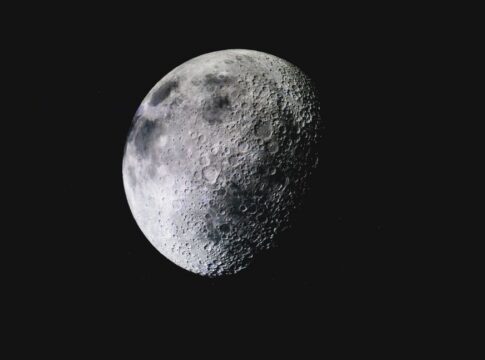
The dark areas visible from Earth, traditionally called “maria” (Latin for “seas”), aren’t bodies of water but rather vast plains of solidified lava. These lunar maria formed between 3 and 4 billion years ago when massive asteroid impacts cracked the Moon’s crust, allowing molten basaltic lava to flow up from the interior and flood enormous basins. The lava eventually cooled and solidified, creating the relatively smooth, dark surfaces we observe today.
These maria cover approximately 16 percent of the lunar surface, with the majority located on the near side facing Earth. The largest of these formations, Mare Imbrium, spans roughly 1,123 kilometers in diameter. The darker appearance of maria compared to the lighter highland regions results from their iron-rich basaltic composition, which reflects less sunlight than the aluminum-rich rocks found in the lunar highlands.
Countless Impact Craters Tell Billions of Years of History
The Moon’s surface is heavily cratered, with scientists estimating that hundreds of thousands of craters larger than one kilometer in diameter pockmark its landscape. The largest confirmed impact crater, the South Pole-Aitken Basin, measures approximately 2,500 kilometers in diameter and reaches depths of 8 kilometers, making it one of the largest known impact structures in the entire solar system.
These craters serve as a geological record of the solar system’s violent history. Without erosion from wind, water, or tectonic activity, lunar craters remain virtually unchanged for billions of years, providing scientists with pristine evidence of ancient impacts. By studying the density and distribution of craters, researchers can determine the relative ages of different lunar surfaces and gain insights into the frequency of impacts throughout solar system history.
Water Ice Exists in Permanently Shadowed Regions
Contrary to earlier beliefs that the Moon was completely dry, recent discoveries have confirmed the presence of water ice in permanently shadowed craters near the lunar poles. These regions never receive direct sunlight, maintaining temperatures cold enough to preserve ice for billions of years. NASA’s Lunar Reconnaissance Orbiter and other missions have detected significant water deposits in these areas, with some craters potentially containing substantial ice reserves.
This discovery has profound implications for future lunar exploration. Water ice could provide drinking water for astronauts, be split into hydrogen and oxygen for rocket fuel, and support long-term human habitation on the Moon. The presence of these ice deposits has made the lunar poles prime targets for future landing sites and potential lunar base locations.
Moonquakes Shake the Lunar Surface
Although the Moon appears geologically dead, it experiences regular moonquakes detected by seismometers placed by Apollo astronauts. Four types of moonquakes occur: deep moonquakes about 700 kilometers below the surface, meteorite impact vibrations, thermal quakes caused by the surface expanding in sunlight, and shallow moonquakes occurring 20 to 30 kilometers below the surface. These shallow moonquakes can reach magnitudes of 5.5 on the Richter scale and last for over 10 minutes, far longer than earthquakes due to the Moon’s dry, rigid composition that allows seismic waves to propagate more efficiently.