
⏱️ 5 min read
Supernovas represent some of the most spectacular and powerful events in the universe, releasing more energy in a few weeks than our Sun will produce in its entire 10-billion-year lifetime. These cosmic explosions have shaped the universe as we know it, creating the heavy elements necessary for life and influencing the formation of new stars and planetary systems. Understanding these celestial phenomena provides insight into the life cycle of stars and the fundamental processes that govern our cosmos.
The Explosive Power of Dying Stars
When a massive star reaches the end of its life, it doesn’t simply fade away quietly. Instead, it explodes with such incredible force that the supernova can briefly outshine an entire galaxy containing billions of stars. The energy released during this explosion is almost incomprehensible—a single supernova can produce more energy in seconds than our Sun will generate throughout its entire existence. This tremendous output makes supernovas visible across vast cosmic distances, sometimes appearing as new stars in Earth’s night sky to observers without telescopes.
The brightness of a supernova peaks within days or weeks of the initial explosion, after which it gradually fades over several months. At maximum brightness, these events can be seen from Earth even during daylight hours in some cases, as historical records have documented.
Two Distinct Types of Stellar Explosions
Astronomers classify supernovas into two main categories based on their spectral signatures and formation mechanisms. Type I supernovas occur in binary star systems where a white dwarf accumulates matter from a companion star. When the white dwarf reaches approximately 1.4 times the mass of our Sun—known as the Chandrasekhar limit—it can no longer support itself against gravitational collapse, triggering a thermonuclear explosion that completely destroys the star.
Type II supernovas, on the other hand, result from the core collapse of massive stars that are at least eight times more massive than our Sun. When these stars exhaust their nuclear fuel, their cores collapse in fractions of a second, while their outer layers rebound and explode outward at speeds reaching 10 percent of the speed of light. This process leaves behind either a neutron star or, in the most massive cases, a black hole.
The Cosmic Factory for Heavy Elements
One of the most important roles supernovas play in the universe is the creation and distribution of heavy elements. The cores of stars produce elements up to iron through nuclear fusion during their normal lifetime, but elements heavier than iron require the extreme conditions found only in supernova explosions. Gold, silver, platinum, uranium, and many other elements essential to modern technology and life itself are forged in these cosmic furnaces.
When a supernova explodes, it scatters these newly created elements across space, enriching the interstellar medium with the raw materials necessary for forming new stars, planets, and potentially life. Every atom of gold in a wedding ring, every molecule of oxygen we breathe, and much of the calcium in our bones originated in ancient supernova explosions that occurred billions of years ago.
Historical Observations Throughout Human Civilization
Throughout recorded history, humans have witnessed and documented supernovas appearing in the night sky. Chinese astronomers recorded a “guest star” in 1054 CE that was visible during daylight for 23 days and remained visible at night for nearly two years. This observation corresponds to the supernova that created the Crab Nebula, one of the most studied objects in astronomy.
Other notable historical supernovas include Tycho’s Supernova in 1572 and Kepler’s Supernova in 1604, both named after the famous astronomers who studied them. These events occurred before the invention of the telescope, demonstrating just how bright supernovas can appear from Earth. Interestingly, no supernova has been visible to the naked eye in our Milky Way galaxy since Kepler’s observation over 400 years ago.
The Supernova Remnants Left Behind
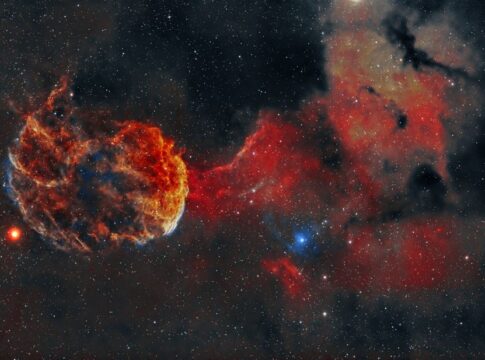
After the initial explosion fades, supernovas leave behind expanding shells of gas and dust called supernova remnants. These structures continue to grow and evolve for thousands of years, creating some of the most beautiful and complex structures observable in space. The expanding shock waves from these remnants compress surrounding gas clouds, often triggering the formation of new stars and continuing the cycle of stellar birth and death.
The material within these remnants can reach temperatures of millions of degrees and emit powerful X-rays and other forms of radiation. Scientists study these remnants to understand the explosion mechanisms, the distribution of elements, and the impact these events have on their galactic neighborhoods.
Supernovas as Cosmic Distance Markers
Type Ia supernovas have proven invaluable to astronomers as “standard candles” for measuring cosmic distances. Because these explosions occur under specific conditions and produce remarkably consistent peak brightness, scientists can determine how far away they are by comparing their apparent brightness to their known absolute brightness. This technique led to the revolutionary discovery in 1998 that the universe’s expansion is accelerating, a finding that earned the Nobel Prize in Physics and introduced the concept of dark energy.
The Future Threat and Opportunity
While supernovas are spectacular events, they could pose a threat to life on Earth if one occurred too close to our solar system. Scientists estimate that a supernova would need to occur within about 30 light-years to significantly affect Earth’s atmosphere and potentially harm life. Fortunately, no known candidates for supernova explosions exist within this danger zone, making Earth safe for the foreseeable future.
Astronomers continue monitoring potential supernova candidates throughout our galaxy and beyond, hoping to catch the next nearby explosion in its earliest moments. Such an event would provide unprecedented opportunities to study these phenomena and deepen our understanding of stellar evolution and cosmic chemistry.