
⏱️ 6 min read
Our solar system is a remarkable cosmic neighborhood filled with wonder, mystery, and extraordinary phenomena. From the blazing furnace of our Sun to the icy reaches beyond Neptune, the celestial bodies that orbit our star offer endless fascination. Understanding these essential facts helps us appreciate our place in the universe and the incredible diversity of worlds that exist relatively close to home.
Essential Facts About Our Cosmic Neighborhood
1. The Sun Contains 99.86% of the Solar System’s Mass
The Sun dominates our solar system in a way that’s difficult to comprehend. This massive star accounts for approximately 99.86% of all the mass in the entire solar system. To put this in perspective, Jupiter, the largest planet, contains most of the remaining 0.14%, while all the other planets, moons, asteroids, and comets combined make up just a tiny fraction. The Sun’s immense gravitational pull is what keeps all celestial bodies in their orbits, from Mercury close to its surface to objects in the distant Oort Cloud. This stellar giant has a diameter of about 1.4 million kilometers, meaning you could fit approximately 1.3 million Earths inside it.
2. A Day on Venus Is Longer Than Its Year
Venus holds one of the most peculiar records in our solar system: it takes longer to complete one rotation on its axis than it does to orbit the Sun. A single Venusian day lasts about 243 Earth days, while its orbital period is only 225 Earth days. Even more unusual, Venus rotates backwards compared to most other planets, spinning from east to west. This retrograde rotation means that on Venus, the Sun rises in the west and sets in the east, creating an astronomical oddity that scientists believe may have resulted from a massive ancient collision.
3. Mars Hosts the Tallest Mountain in the Solar System
Olympus Mons on Mars stands as the undisputed champion of mountains in our solar system. This colossal shield volcano towers approximately 21 kilometers above the Martian surface, making it nearly three times the height of Mount Everest. Its base spans roughly 600 kilometers in diameter, an area comparable to the entire state of Arizona. Despite its massive height, Olympus Mons has gentle slopes averaging only five degrees, meaning if you stood on its surface, you wouldn’t even realize you were on the side of a mountain due to the curvature of Mars and the volcano’s gradual incline.
4. Saturn Could Theoretically Float in Water
Saturn possesses such a low density that it would float if you could find a body of water large enough to accommodate it. With an average density of just 0.687 grams per cubic centimeter, Saturn is less dense than water (1 gram per cubic centimeter). This remarkable characteristic results from its composition, being made primarily of hydrogen and helium gases. The planet’s famous rings, composed of ice particles and rocky debris, add to its spectacular appearance but contribute little to its overall mass. Saturn’s low density makes it the least dense planet in our solar system by a significant margin.
5. Jupiter’s Great Red Spot Is a Storm Older Than the United States
The Great Red Spot, Jupiter’s most iconic feature, is an enormous anticyclonic storm that has been raging for at least 400 years, possibly much longer. First observed by astronomers in the 1600s, this massive storm is large enough to swallow two or three Earths. Wind speeds within the storm reach up to 680 kilometers per hour. Recent observations have shown that the Great Red Spot is actually shrinking, though it remains one of the most powerful and persistent weather systems ever observed. The storm’s distinctive red color likely comes from complex chemical reactions involving the planet’s atmospheric compounds.
6. Mercury Experiences Extreme Temperature Swings
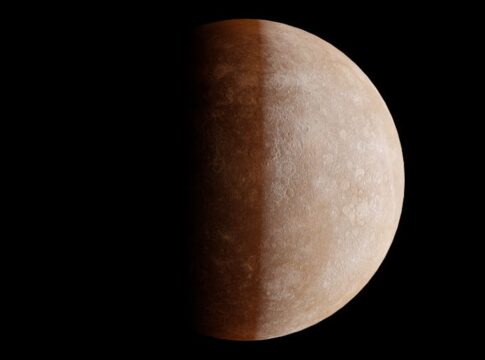
Mercury, the closest planet to the Sun, endures the most dramatic temperature variations in the solar system. During the day, surface temperatures can soar to 430 degrees Celsius, hot enough to melt lead. However, at night, temperatures plummet to minus 180 degrees Celsius. This 610-degree swing occurs because Mercury has virtually no atmosphere to retain heat, and its slow rotation means each side faces prolonged periods of intense sunlight followed by extended darkness. Additionally, ice has been discovered in permanently shadowed craters at Mercury’s poles, existing just a few hundred kilometers from some of the hottest spots in the solar system.
7. Neptune Has the Fastest Winds of Any Planet
Despite being the farthest planet from the Sun and one of the coldest, Neptune experiences the most violent winds in the solar system. These winds can reach extraordinary speeds of up to 2,100 kilometers per hour, faster than the speed of sound on Earth. Scientists remain puzzled about what generates such powerful winds on a planet that receives so little solar energy. Neptune’s dynamic atmosphere also features large storm systems, including the famous Great Dark Spot observed by Voyager 2 in 1989, though unlike Jupiter’s Great Red Spot, Neptune’s storms appear to be more transient.
8. The Asteroid Belt Contains Only 4% of the Moon’s Mass
Contrary to popular depictions in science fiction, the asteroid belt between Mars and Jupiter is remarkably empty. While it contains millions of asteroids, their combined mass equals only about 4% of Earth’s Moon. The largest object in the asteroid belt is the dwarf planet Ceres, which accounts for approximately one-third of the belt’s total mass. Spacecraft have successfully navigated through the asteroid belt multiple times without incident, as the asteroids are typically millions of kilometers apart. This region represents material that never coalesced into a planet, likely due to Jupiter’s powerful gravitational influence.
9. Earth Is the Only Planet Not Named After a Deity
While Mercury, Venus, Mars, Jupiter, Saturn, Uranus, and Neptune all derive their names from Roman and Greek gods, Earth’s name comes from Germanic and Old English words meaning “ground” or “soil.” The name has been in use for at least 1,000 years, long before we understood that Earth was a planet orbiting the Sun. In many other languages, Earth also has names rooted in terrestrial concepts rather than mythology. This linguistic distinction reflects humanity’s historical perspective of Earth as fundamentally different from the celestial objects we observed in the sky.
10. Uranus Rotates on Its Side
Uranus has the most extreme axial tilt of any planet in the solar system, rotating at an angle of approximately 98 degrees. This means the planet essentially rolls around the Sun on its side, with its poles taking turns pointing almost directly at the Sun during its 84-year orbit. Scientists theorize that this unusual orientation resulted from a massive collision with an Earth-sized object billions of years ago. This peculiar tilt creates extreme seasonal variations on Uranus, where each pole experiences 42 years of continuous sunlight followed by 42 years of darkness. This unique characteristic makes Uranus one of the most intriguing planets for atmospheric and seasonal studies.
Understanding Our Cosmic Home
These ten remarkable facts illustrate the incredible diversity and wonder present in our solar system. From the Sun’s overwhelming dominance to the peculiar characteristics of individual planets, each element contributes to the complex and fascinating cosmic environment we call home. As exploration continues and technology advances, we continue to uncover new mysteries and deepen our understanding of these celestial neighbors that share our journey around the Sun.